I’ve decided to deal with the new social media technologies individually to describe what it is, show ways to use them for PR and offer resources. Since this is a blog, I’m going to start there. (Note, the information I am sharing here is what I’m learning as a beginner.)
In the survey I conducted a couple of weeks ago, every one of the respondents said they either know or “kind of” know what a blog is. You obviously do since you’re reading one right now.
I’ve heard lots of people say a blog is an online journal or web diary. (If that’s all it is, then it’s not really useful to me in my own work.) I know of one CEO who thinks the blogworld is just like talk radio with a lot of people spouting of their opinions ad nauseam toward no larger purpose. (Yes, I know that’s a narrow view of talk radio. But you can understand where it comes from.)
The big picture though is that a blog is really just a type of web site. Eric Schwartzman says it’s a way for “anybody to publish to the Internet for free and to be heard” Also, people don’t have to do something special to access it (like registering for a discussion board or usenet group). Plus it’s really easy to use.
The main difference I see between a typical web site and a blog though, is that a web site is usually one-way communication. It may be highly interactive, targeted, great communication. But most are essentially one-way. At least they are when compared to blogs. Blogs are intended to be places for dialog. I’ve seen several PR blogs talking about how to foster a community dialog via a blog. Neville Hobson says blogs “give people another means, an easy means from a technological point of view, to tell a story, and that’s a basic human need to communicate” (Stated on On the Record 3-3-06 podcast).
So, blogs can serve quite a number of communication purposes. Primarily, they can help you engage your key audiences. They can help you tell your story. They can be used to exchange ideas and learn ways to improve your products, services, etc. They can be used in a crisis to exchange information fast without having to fit it into your main web site’s structure. And much more.
The best way to learn about them is to visit some and to enter the conversation. What are your favorites?
Thursday, April 27, 2006


Wednesday, April 26, 2006
Stormhoek Geek Dinner Campaign Worth Watching
So, Hugh put up a little announcement of our San Antonio blogger lunch kicking off the 100 Geek Dinners and I just got a call from Samantha from Stormhoek, (Yes Sam, I got the message) saying a parcel was “on the way.”
Hugh points to a great post by the blog Good Grape that puts this campaign into a bottom-line perspective that any corporate executive could understand. Hugh used the same kind of blogging campaign to introduce the wine in the UK, doubling sales from 50,000 cases in 2004 to 100,000 cases in 2005. Now those are measurable results!
It is worth a read to understand this type of campaign from a public relations perspective. And I will be watching the campaign, and its numbers, as it progresses in the U.S.
In the meanwhile we will have a little fun participating in the campaign next week.
Join us if you can.
Salud!
Tags:
Hugh points to a great post by the blog Good Grape that puts this campaign into a bottom-line perspective that any corporate executive could understand. Hugh used the same kind of blogging campaign to introduce the wine in the UK, doubling sales from 50,000 cases in 2004 to 100,000 cases in 2005. Now those are measurable results!
It is worth a read to understand this type of campaign from a public relations perspective. And I will be watching the campaign, and its numbers, as it progresses in the U.S.
In the meanwhile we will have a little fun participating in the campaign next week.
Join us if you can.
Salud!
Tags:
San Antonio Meetup: First in Hugh McLeod’s 100 Geek Dinners
 Except it will be lunch.
We will talk about social media in San Antonio, and there will be a wine tasting of Stormhoek wine, a new product coming to the U.S. market this year.
Don’t worry, it will just be a tasting, you will be able to return to work afterward. Unless, of course, you don’t want to go back to work ;-)
The meetup idea was born when Alan L. Weinkrantz, www.alanweinkrantz.typepad.com
who is also a PR blogger here in San Antonio, and I planned to meet on May 1, which happened to coincide with Hugh McLeod’s 100 Geek Dinners in 100 days (May 1-
August 9, 2006).
So lucky us, we will be the first of the 100 dinners (lunch in this case).
If you will be in San Antonio on May 1 and want to meet up with us, please contact me via e-mail at kami (at) yahoo (dot) com. I need a head count pretty quickly because Stormhoek needs to know how much wine to send.
We haven’t settled on a final location yet, but we are looking at Central Market, 12 noon on May 1, 2006. I will keep the RSVP crowd apprised on the final location via e-mail and I will also post it the day of the event here.
Tags:
Sunday, April 23, 2006
Starting Out
When a person enters college as a freshman, whether it be at a 2 year community college or a 4 year university, it can be very daunting. Even more daunting if you are a non-traditional student. You enter not quite knowing what you want to major in, you just know it is time to make a change in your life. It is said that, 'admitting changes need to be made, is the first step to anything.'
I realized after three semesters at San Antonio College that I wanted my major to be Communication. It was not until transferring, to the University of Texas at San Antonio (UTSA), that I realized I wanted my concentration to be Public Relations, later deciding to add Technical Communication with it.
I am excited that I chose these concentrations because they are beginning to open up doors. Besides contributing here I have recently been elected President of the UTSA Chapter of PRSSA for 2006-2007. I was actually blessed because I will be working with some really great individuals whom I have worked with previously on school projects, etc. One of those is my Vice President Cynthia Hokanson. We have been in several classes together over the last year and we work very good together.
While we look forward to the new year, we also have some apprehensions. Our organization has had decreasing membership participation. The most disturbing issue is, that when individuals have joined in the past, they have only joined for the purpose of padding their resume. I bring this up, because as a new leader I am looking for any advice that all of the PR professionals out there may have to help us to generate some new life and excitement into our organization.
We are also hoping that some of you might suggest some great fundraising ideas that will push us in the right direction, while allowing us the opportunity to generate greater participation. While diong so we also want to let the members know how important they are to us. What are some suggestions from outside of the box (campus).
There was a time from 2000-2004 when the UTSA Chapter of PRSSA was recognized nationally. We would like to work towards being nationally recognized again and going further. We welcome any suggestions of how we can accomplish this goal. Part of how we can do this is by creating PR campaigns, press releases, and many of the other aspects that are included in Public Relations.
If there are any individuals who would be intersted in being mentors we would definitely be interested in hearing your suggestions and would greatly appreciate your mentorship.
If you have suggestions or are just simply interested in our organization feel free to contact me.
I realized after three semesters at San Antonio College that I wanted my major to be Communication. It was not until transferring, to the University of Texas at San Antonio (UTSA), that I realized I wanted my concentration to be Public Relations, later deciding to add Technical Communication with it.
I am excited that I chose these concentrations because they are beginning to open up doors. Besides contributing here I have recently been elected President of the UTSA Chapter of PRSSA for 2006-2007. I was actually blessed because I will be working with some really great individuals whom I have worked with previously on school projects, etc. One of those is my Vice President Cynthia Hokanson. We have been in several classes together over the last year and we work very good together.
While we look forward to the new year, we also have some apprehensions. Our organization has had decreasing membership participation. The most disturbing issue is, that when individuals have joined in the past, they have only joined for the purpose of padding their resume. I bring this up, because as a new leader I am looking for any advice that all of the PR professionals out there may have to help us to generate some new life and excitement into our organization.
We are also hoping that some of you might suggest some great fundraising ideas that will push us in the right direction, while allowing us the opportunity to generate greater participation. While diong so we also want to let the members know how important they are to us. What are some suggestions from outside of the box (campus).
There was a time from 2000-2004 when the UTSA Chapter of PRSSA was recognized nationally. We would like to work towards being nationally recognized again and going further. We welcome any suggestions of how we can accomplish this goal. Part of how we can do this is by creating PR campaigns, press releases, and many of the other aspects that are included in Public Relations.
If there are any individuals who would be intersted in being mentors we would definitely be interested in hearing your suggestions and would greatly appreciate your mentorship.
If you have suggestions or are just simply interested in our organization feel free to contact me.
Saturday, April 22, 2006
Just Why are PR Folk Moving “Slowly” into Social Media?
The posts I’ve been adding to this blog lately have focused on our use of blogging and other social media among San Antonio PR folk. The other day, I listened to an excellent podcast interview of Sally Falkow, APR, president and senior web strategist of Expansion Plus. Among other things, she discussed why so many PR folk are slow to adopt these new technologies for their companies and clients. One theory she offered was our perception that social media are highly technical and hard to learn. The host of the podcast, Eric Schwartzman, argued that it’s not that difficult to learn. Sally said, true, but it doesn’t matter. That’s the perception.
I think it’s more than that. We’re not afraid of trying something hard. But this is new, and it takes time to learn about it, to learn how, to learn why and to learn when. I, for one, am a working mom with a great but demanding job and two young children. Time is a commodity I don’t have much of.
So why, do you ask, am I blogging right now? I am lucky to have an employer who not only supports me in learning new things but also is pushing her staff to learn and apply new technologies. That includes giving us room to mess it up.
Part of my organization’s work involves providing really good professional development for public school teachers. One of the things we know that has to be in place for innovations to take hold, is for the teachers to be supported in their learning and trying out new things. The same is true in all disciplines.
The other reason I am blogging is because I feel it is my responsibility as our communications manager to continue to learn about new trends, new technologies and more effective communication strategies.
What do you think? Have we been slow to adopt these new technologies? If so, why?
I also suggest you listen to the On the Record podcast interview of Sally Falkow. It’s the show dated April 11, 2006. You don’t have to have an Ipod or Mp3 player to listen. Computer speakers are enough.
One last point. “Slow” is a relative term. To those who are early adopters, you know, those who stand in line and pay tons of money for every new gadget there is, to those people, we are slow. But for many of us, within our organizations and our circles, we’ll be the first. To them, we’re nowhere near slow.
I think it’s more than that. We’re not afraid of trying something hard. But this is new, and it takes time to learn about it, to learn how, to learn why and to learn when. I, for one, am a working mom with a great but demanding job and two young children. Time is a commodity I don’t have much of.
So why, do you ask, am I blogging right now? I am lucky to have an employer who not only supports me in learning new things but also is pushing her staff to learn and apply new technologies. That includes giving us room to mess it up.
Part of my organization’s work involves providing really good professional development for public school teachers. One of the things we know that has to be in place for innovations to take hold, is for the teachers to be supported in their learning and trying out new things. The same is true in all disciplines.
The other reason I am blogging is because I feel it is my responsibility as our communications manager to continue to learn about new trends, new technologies and more effective communication strategies.
What do you think? Have we been slow to adopt these new technologies? If so, why?
I also suggest you listen to the On the Record podcast interview of Sally Falkow. It’s the show dated April 11, 2006. You don’t have to have an Ipod or Mp3 player to listen. Computer speakers are enough.
One last point. “Slow” is a relative term. To those who are early adopters, you know, those who stand in line and pay tons of money for every new gadget there is, to those people, we are slow. But for many of us, within our organizations and our circles, we’ll be the first. To them, we’re nowhere near slow.
Tuesday, April 18, 2006
Technology Use in Alamo City PR
I conducted a written survey of participants at last week’s PRSA San Antonio chapter luncheon. The survey was informal, unscientific and voluntary. In it, I asked basic questions about their use of blogs, RSS feeds, podcasts, webcasts, e-mail updates, and web-based media rooms. The results show that the least known technology among our folk is the RSS feed (37 percent said they don’t know what it is). Over three quarters either know or “kind of” know what the other technologies are.
When asked if their organization provides these technologies, most said no, with the exception of e-mail updates (89 percent do provide them). About a quarter provide blogs and RSS feeds, and two of five provide webcasts and media rooms.
The third question asked whether they use these technologies in their work. Almost all respondents use e-mail updates often or sometimes in their work (96 percent). Over half use webcasts (63 percent) and media rooms (57 percent). And a small group use blogs (42 percent), RSS feeds (39 percent) and podcasts (31 percent).
For those whose organizations do provide these technologies, only 30 percent said PR people are involved in the planning or development, and 26 percent are “kind of” involved.
Just over half of the organizations represented are planning to expand their technology use in the next six months.
Out of about 65 people, I received 27 responses, which is about a 42 percent response rate. Two out of five respondents were from non-profit organizations and almost one-third were from corporate or business. Another 15 percent work with education institutions. Naturally, there is some repetition among responses since some participants work with the same organizations. Also, some respondents were confused by the term “media room,” as I was not clear that I was referring to web sites. (More on that point later.)
How are you using technology for public relations purposes? Post a comment to share.
When asked if their organization provides these technologies, most said no, with the exception of e-mail updates (89 percent do provide them). About a quarter provide blogs and RSS feeds, and two of five provide webcasts and media rooms.
The third question asked whether they use these technologies in their work. Almost all respondents use e-mail updates often or sometimes in their work (96 percent). Over half use webcasts (63 percent) and media rooms (57 percent). And a small group use blogs (42 percent), RSS feeds (39 percent) and podcasts (31 percent).
For those whose organizations do provide these technologies, only 30 percent said PR people are involved in the planning or development, and 26 percent are “kind of” involved.
Just over half of the organizations represented are planning to expand their technology use in the next six months.
Out of about 65 people, I received 27 responses, which is about a 42 percent response rate. Two out of five respondents were from non-profit organizations and almost one-third were from corporate or business. Another 15 percent work with education institutions. Naturally, there is some repetition among responses since some participants work with the same organizations. Also, some respondents were confused by the term “media room,” as I was not clear that I was referring to web sites. (More on that point later.)
How are you using technology for public relations purposes? Post a comment to share.
Wednesday, April 12, 2006
Controversy Over VNRs Continue
A new research study called Fake TV News was released last week by the Center for Media and Democracy taking aim at the Video News Release, a product used by public relations organizations to get the word out on television news.
The study followed 36 video news releases (watch them all here) and analyzed how they were used by media newsrooms. To say the least, the report was extremely biased, using phrasing that implies wongdoing and discounts any value of the VNR medium.
The Public Relations Society of America’s advocacy committee responded by making its board members available for comment and by sending a letter to the FCC, which also included a response to comments by Federal Communications Commission Chairman Kevin Martin, who last week told publishers at the Newspaper Association of America's (NAA) annual convention that he is committed to overturning a ban on same-market cross-ownership.
(More analysis on original post at Communication Overtones)
The study followed 36 video news releases (watch them all here) and analyzed how they were used by media newsrooms. To say the least, the report was extremely biased, using phrasing that implies wongdoing and discounts any value of the VNR medium.
The Public Relations Society of America’s advocacy committee responded by making its board members available for comment and by sending a letter to the FCC, which also included a response to comments by Federal Communications Commission Chairman Kevin Martin, who last week told publishers at the Newspaper Association of America's (NAA) annual convention that he is committed to overturning a ban on same-market cross-ownership.
(More analysis on original post at Communication Overtones)
Tags:
Friday, April 07, 2006
What I took away from, "Knock, Knock: How to Handle a Reporter with an Agenda!"
As a member of PRSSA, the greatest benefit I have is being able to go to the monthly PRSA Luncheon. This month was no different. The guest speaker was Greg Flores,vice presidentof communication and community relations with the San Antonio Water System.
The title of the topic was, "Knock, Knock: How to Handle a Reporter with an Agenda." After discussing his own background, Mr. Flores discussed in depth several steps in an organizations' steps to improving social responsibility. He opened and closed with what I took as the most important message. When it comes to social responsibility, "the best spin is no spin." For me, this means that whether I am writing for this blog or working as a professional in an organization, everything I do or say must be a positive reflection of that position.
The first step is to build good, strong relationships with the media. This takes some effort and nurturing. As you are nurturing these relationships you will be building the most important aspect and that is credibility. Especially since it seems as though journalists today work harder to find the negative stories. With this in mind an individual should strive to look for the positive stories within their organization. While being proactive, you are able to provide those positive stories to the press, in the process possibly correcting a negative story headed for print.
Mr. Flores reminded us of the importance of excellent community relations. An organization needs to look at the entire picture, not just within the corporate box. If an organization works with members of different community activist organizations, as is the case with several municipal entities in San Antonio, then it is able to allow the community as a whole to see that it is socially responsible. Part of the community relations is also making sure that the organization is constantly in touch with the outside, again looking past the borders of the organizational box.
Another topic that Mr. Flores discussed also fit into the community relations aspect for me. He suggested that when an organization decides to give, whether it be donating time, money, etc. it should find ways of giving that are not seen everyday. For me an example of this would be the homebuilding corporations that donate their time and resources as is the case on ABC's, "Extreme Makeover: Home Edition." One final area within community relations that Mr. Flores talked about was how an organization can measure its success. The best way to measure success is to serve the community in whatever ways the organization can. This way, your social responsibility will always be one of the ways the media will remember you, as opposed to only remembering the negative stories about the company.
One of the ways for an organization to be socially responsible is to make sure that their public relations program and the company's mission statement are strategically aligned, This means that if a healthcare organization states in their, "We will strive to provide the best healthcare to the citizens of Bexar County and South Texas," within their mission statement, then every message that their public relations department disseminates should reflect that statement.
Government relations are also very important in the realm of social responsibility. A company must adhere to governmental regulations regarding environmental issues, pricing, and any number of issues. If a company remains on top of all issues that affect their organization then they are nurturing their government relations along with community relations. Within this area I found that it was very true when Mr. Flores pointed out that what an organization says can have very legal consequences.
An important point that Mr. Flores made was that an organizations' own internal relations can play a major role in how they carry out their social responsibility. An example that I remember personally came from when I was a team manager for Sitel Corporation from 1999-2001. My relationship with my employees made a big difference in how they did their jobs in business to business marketing. My own excellent internal relations garnered me several client and corporate recognitions.
I took a great deal away from Mr. Flores' discussion. It was another educational experience which will continue to influence me in my future writings of press releases and public service announcements.
The title of the topic was, "Knock, Knock: How to Handle a Reporter with an Agenda." After discussing his own background, Mr. Flores discussed in depth several steps in an organizations' steps to improving social responsibility. He opened and closed with what I took as the most important message. When it comes to social responsibility, "the best spin is no spin." For me, this means that whether I am writing for this blog or working as a professional in an organization, everything I do or say must be a positive reflection of that position.
The first step is to build good, strong relationships with the media. This takes some effort and nurturing. As you are nurturing these relationships you will be building the most important aspect and that is credibility. Especially since it seems as though journalists today work harder to find the negative stories. With this in mind an individual should strive to look for the positive stories within their organization. While being proactive, you are able to provide those positive stories to the press, in the process possibly correcting a negative story headed for print.
Mr. Flores reminded us of the importance of excellent community relations. An organization needs to look at the entire picture, not just within the corporate box. If an organization works with members of different community activist organizations, as is the case with several municipal entities in San Antonio, then it is able to allow the community as a whole to see that it is socially responsible. Part of the community relations is also making sure that the organization is constantly in touch with the outside, again looking past the borders of the organizational box.
Another topic that Mr. Flores discussed also fit into the community relations aspect for me. He suggested that when an organization decides to give, whether it be donating time, money, etc. it should find ways of giving that are not seen everyday. For me an example of this would be the homebuilding corporations that donate their time and resources as is the case on ABC's, "Extreme Makeover: Home Edition." One final area within community relations that Mr. Flores talked about was how an organization can measure its success. The best way to measure success is to serve the community in whatever ways the organization can. This way, your social responsibility will always be one of the ways the media will remember you, as opposed to only remembering the negative stories about the company.
One of the ways for an organization to be socially responsible is to make sure that their public relations program and the company's mission statement are strategically aligned, This means that if a healthcare organization states in their, "We will strive to provide the best healthcare to the citizens of Bexar County and South Texas," within their mission statement, then every message that their public relations department disseminates should reflect that statement.
Government relations are also very important in the realm of social responsibility. A company must adhere to governmental regulations regarding environmental issues, pricing, and any number of issues. If a company remains on top of all issues that affect their organization then they are nurturing their government relations along with community relations. Within this area I found that it was very true when Mr. Flores pointed out that what an organization says can have very legal consequences.
An important point that Mr. Flores made was that an organizations' own internal relations can play a major role in how they carry out their social responsibility. An example that I remember personally came from when I was a team manager for Sitel Corporation from 1999-2001. My relationship with my employees made a big difference in how they did their jobs in business to business marketing. My own excellent internal relations garnered me several client and corporate recognitions.
I took a great deal away from Mr. Flores' discussion. It was another educational experience which will continue to influence me in my future writings of press releases and public service announcements.
Thursday, April 06, 2006
New Beginnings
There are times when you might think to yourself, "How did I get here?". Especially if you are a non-traditional college student wanting to start anew. I say this because I am one of those individuals. I began my college years at the age of 36. I am a junior at the University of Texas at San Antonio, working on a double B.A. in Communication, with my concentrations being Public Relations and Technical Communication.
I chose those two conentrations because I have a passion for writing and I have a passion for seeing others succeed. With my degrees I will be able to do both, while allowing myself grow both personally and professionally.
The reason for today's blog is that it begins my personal and professional journey into the world of PR. When I was asked by Kami Huyse, APR to join this blog with a student's perspective from the only chapter of the PRSSA, I gladly accepted. This is the beginning of a journey that is going to be extremely educational and beneficial as I enter the Public Relations field.
I look forward to contributing, as well as hearing feedback from the professionals willing to teach me and help me grow into a long and exciting career.
I chose those two conentrations because I have a passion for writing and I have a passion for seeing others succeed. With my degrees I will be able to do both, while allowing myself grow both personally and professionally.
The reason for today's blog is that it begins my personal and professional journey into the world of PR. When I was asked by Kami Huyse, APR to join this blog with a student's perspective from the only chapter of the PRSSA, I gladly accepted. This is the beginning of a journey that is going to be extremely educational and beneficial as I enter the Public Relations field.
I look forward to contributing, as well as hearing feedback from the professionals willing to teach me and help me grow into a long and exciting career.
Blog Bandwagon: Even 85-Year-Olds Do It
It seems that everyone is talking about blogs and blogging these days. Sometimes it makes you wonder if these things are around to stay or are just another fad. I’ve heard all of the excuses:
Well, here is something to blow all of those excuses out of the water.
Industry luminary and Founding Chairman of Burson-Marsteller, Harold Burson, has a blog.
Burston-Marsteller is one of the leading public relations agencies in the world.
Indeed, Burson has been blogging since February and posts about once a month. He is 85 years-old and still shows up at the office every day. Now, that’s dedication!
The blog is called Insights, and it lives up to its name. His posts are educational and full of historical perspective about the profession in the 21st century.
Posts include:
Still Another Lincolnian Attribute: A Sense of Public Relations
The Role of the Public Relations Counselor
Reflections on Reaching 85... Are We Getting it Right?
Being in the Know...
- You can’t teach an old dog new tricks
- I don’t have time to be a blogger or read all of those millions of blogs out there
- Isn’t information on blogs suspect?
Well, here is something to blow all of those excuses out of the water.
Industry luminary and Founding Chairman of Burson-Marsteller, Harold Burson, has a blog.
Burston-Marsteller is one of the leading public relations agencies in the world.
Indeed, Burson has been blogging since February and posts about once a month. He is 85 years-old and still shows up at the office every day. Now, that’s dedication!
The blog is called Insights, and it lives up to its name. His posts are educational and full of historical perspective about the profession in the 21st century.
Posts include:
Still Another Lincolnian Attribute: A Sense of Public Relations
The Role of the Public Relations Counselor
Reflections on Reaching 85... Are We Getting it Right?
Being in the Know...
Tags:
Thursday, March 30, 2006
Blogfree Companies in San Antonio
In my last post, I wondered how many companies in San Antonio have entered the blog world. I decided to see for myself.
First let me explain the process I used. Disclaimer #1: I selected the top 10 San Antonio Area Publicly Traded Companies as listed by the San Antonio Business Journal in late 2005. I did not look at more than 10 or at any private companies. Disclaimer #2: I used Google to find their web sites and checked the contact info to make sure I had the right company. Disclaimer #3: I reviewed the home page and some pages that were only one click away from the home page. I did not investigate every page. I spent about two minutes per site -- because I have a life to get on with.
Here are the companies I reviewed
- Valero Energy Corp
- AT&T (formerly SBC Communications)
- Tesoro Corporation
- Clear Channel Communications Inc
- Rush Enterprises Inc
- Harte-Hanks Inc
- Kinetic Concepts Inc
- Argonaut Group Inc
- Cullen/Frost Bankers Inc
- Alamo Group Inc
Here’s what I found
Of the top 10 San Antonio Area Publicly Traded Companies zero have blogs from the executive office or anywhere else that I could find. None provide RSS feeds. Three provide podcasts or webcasts regarding investor relations activities (Tesoro, Kinetic Concepts, Argonaut Group). And four provide some kind of listserv for email updates (AT&T, Clear Channel, Kinetic Concepts, Argonaut Group). The audience and purpose of those updates varies by company.
Clear Channel of course does offer podcasts through many of its stations, but not from its corporate office, which is probably by design. This brings me to another point. Just because “everybody” is doing it, is not a good reason to start a company blog. In fact, that’s a potentially disastrous reason. It has to be part of a larger communication or engagement strategy.
Friday, March 24, 2006
PR, the Umbrella Over Marketing?
The San Antonio APR Lunch and Learn study group met this week to start its studies to take the Accreditation in Public Relations exam later this year. One of the things we talked about was the role of public relations and how it relates to marketing.

One of the group mentioned that marketing students learn that marketing should serve as the umbrella under which PR, and a number of other communications functions such as advertising, should fall.
Yesterday, in a post on the Auburn University student’s Forward blog, guest blogger Pete Pepinksy of Lewis Communications, a member of the Auburn University PR Advisory Council, wrote just the opposite:
As the basis of his argument he uses the book, The Fall of Advertising and the Rise of PR, by Al and Laura Ries.
This is a book I have been meaning to read, but haven’t found the time for yet. I will add it to my “must read” list in the next few months.
Also, take a moment to visit the Forward blog from time to time, it is a great example of how some students are learning how to use social media and evaluate things critically in their chosen profession.
Yesterday, in a post on the Auburn University student’s Forward blog, guest blogger Pete Pepinksy of Lewis Communications, a member of the Auburn University PR Advisory Council, wrote just the opposite:
Whatever textbook definitions you’ve learned about how advertising, PR and marketing fit together, I see PR as the umbrella, with the others as subordinate tools or approaches to PR objectives.
As the basis of his argument he uses the book, The Fall of Advertising and the Rise of PR, by Al and Laura Ries.
This is a book I have been meaning to read, but haven’t found the time for yet. I will add it to my “must read” list in the next few months.
Also, take a moment to visit the Forward blog from time to time, it is a great example of how some students are learning how to use social media and evaluate things critically in their chosen profession.
Tags:
Wednesday, March 22, 2006
It’s the Strategy, Stupid
CyberAlert has just released its latest issue of Media Monitoring News that includes an article on “Planning a Successful Business Blog.” Below are the tips, each of which is described in more detail in the article.
Most Big Companies Are Ignoring the Blogosphere
At the end of the article are links to several other articles on business blogs and samples of good business blogs. One of the articles, “The Inside Story on Company Blogs” (from Business Week, Feb. 2006) states that only 22 of the 500 largest U.S. companies operate public blogs from their “executive suites.”
Another article, “Why there’s no escaping the blog” from Fortune states: “The blog--short for weblog--can indeed be, as Scoble and Gates say, fabulous for relationships. But it can also be much more: a company’s worst PR nightmare, its best chance to talk with new and old customers, an ideal way to send out information, and the hardest way to control it. Blogs are challenging the media and changing how people in advertising, marketing, and public relations do their jobs. A few companies like Microsoft are finding ways to work with the blogging world--even as they're getting hammered by it. So far, most others are simply ignoring it.”
I’d be curious to see how many San Antonio companies are still ignoring it.
More Tips
By the way, a second article provided by Cyber Alert focuses on “Implementing a Successful Business Blog” with the steps of “selecting development tools, working out a content plan for launch making a debut, developing a style and personality, handling responses, monitoring consumer discussion on your subject, and enjoying the process.”
- Tip #1: Pick Your Subject
- Tip #2: Define Your Mission
- Tip #3: Identify Your Target Audience
- Tip #4: Survey the Landscape
- Tip #5: Recruit Your Blogger(s)
- Tip #6: Refine Your Subject/Mission and Differentiate Your Blog
- Tip #7: Recruit a Champion
- Tip #8: Pull the Plug or Start Implementation
Most Big Companies Are Ignoring the Blogosphere
At the end of the article are links to several other articles on business blogs and samples of good business blogs. One of the articles, “The Inside Story on Company Blogs” (from Business Week, Feb. 2006) states that only 22 of the 500 largest U.S. companies operate public blogs from their “executive suites.”
Another article, “Why there’s no escaping the blog” from Fortune states: “The blog--short for weblog--can indeed be, as Scoble and Gates say, fabulous for relationships. But it can also be much more: a company’s worst PR nightmare, its best chance to talk with new and old customers, an ideal way to send out information, and the hardest way to control it. Blogs are challenging the media and changing how people in advertising, marketing, and public relations do their jobs. A few companies like Microsoft are finding ways to work with the blogging world--even as they're getting hammered by it. So far, most others are simply ignoring it.”
I’d be curious to see how many San Antonio companies are still ignoring it.
More Tips
By the way, a second article provided by Cyber Alert focuses on “Implementing a Successful Business Blog” with the steps of “selecting development tools, working out a content plan for launch making a debut, developing a style and personality, handling responses, monitoring consumer discussion on your subject, and enjoying the process.”
Tuesday, March 14, 2006
Taking the Plunge into New Technologies
I remember sitting in a seminar sponsored by our chapter 10 years ago on “Communicating in a Wired World.” Speakers included some of the greats, like Shel Holtz and Charles Pizzo. Most of the participants had never traversed the Internet. We were there to learn how the Internet would impact our work. Many of us needed data to help convince bosses and clients to create web sites. Our primary homework assignment was to take the plunge and get online. Can you imagine?!?!?
Today, we are in a similar situation with blogs, rss, pods, wikis, etc. I suspect that in a few years, we will look back to today and giggle. But honestly, it takes time to figure out this new stuff and to find ways to work it in to our day-to-day work.
My office has been using RSS feeds on our Intranet site for over a year now to stay up to date on education news. Soon, we’ll be sending out RSS feeds through our redesigned web sites.
We’ve also begun to dabble in podcasting. For starters, we have looked for opportunities to record our executive director when she is making a speech somewhere (sample). Right now, we’re working on one from a teleseminar that she led recently. (And, no, a teleseminar is not a new technology, but we’re using them in new ways, such as with web casts.) The recent teleseminar resulted in many inquiries about our dropout prevention program and one contract already signed. This means that this 90-minute phone call was more productive than last year’s direct mail campaign to 18,000 people. By posting excerpts of that phone call presentation as podcasts, we’ll be able leverage it even further.
How are you using new technologies? Post your stories here under “Comments.” Come back often for new ideas!
Today, we are in a similar situation with blogs, rss, pods, wikis, etc. I suspect that in a few years, we will look back to today and giggle. But honestly, it takes time to figure out this new stuff and to find ways to work it in to our day-to-day work.
My office has been using RSS feeds on our Intranet site for over a year now to stay up to date on education news. Soon, we’ll be sending out RSS feeds through our redesigned web sites.
We’ve also begun to dabble in podcasting. For starters, we have looked for opportunities to record our executive director when she is making a speech somewhere (sample). Right now, we’re working on one from a teleseminar that she led recently. (And, no, a teleseminar is not a new technology, but we’re using them in new ways, such as with web casts.) The recent teleseminar resulted in many inquiries about our dropout prevention program and one contract already signed. This means that this 90-minute phone call was more productive than last year’s direct mail campaign to 18,000 people. By posting excerpts of that phone call presentation as podcasts, we’ll be able leverage it even further.
How are you using new technologies? Post your stories here under “Comments.” Come back often for new ideas!
Monday, March 13, 2006
PR Pros Benefit from Forward Thinking
 This morning in the Daily Dog, Jeremy Pepper points us Forward.
Started by Auburn student Erin Caldwell, the Web site is part blog, part webzine, and is aimed at young PR pros.
Erin is also looking for contributors for the site, including occasional guest contributors, and seasoned principal contributors and entry-level associate contributors that will post at least once a week.
She also opened the site to Forward investors who will engage in communication through comments and contribute and link to its content. She doesn’t say anything about money, but I am sure that will come in time ;-)
The site, which started on March 10th, already includes about ten posts from a number of different authors, including a post about basic RSS and choosing a feed reader, a fun piece about qualifiers (or what the author calls weasel words), plus much more.
Visit Forward and leave a comment or two, and if you have a great post for young PR pros, ask Erin to republish it at Forward or better yet, become a regular contributor.
First published in Communication Overtones.
Tags:
Monday, March 06, 2006
407 PR Blogs Worldwide
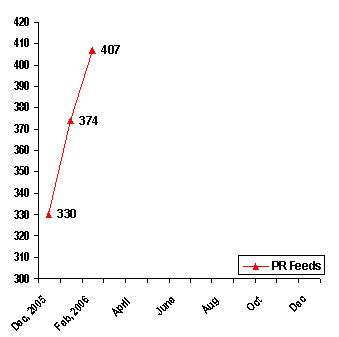 Blogs on the topic of PR are on the rise. Constantin Basturea, who is a keeper of the "official" PR blog lists reports an addition of 55 new PR feeds in the month of February alone, bringing the total number of PR feeds to 407, an increase of 9 percent over January.
(Note: For you math majors, I am aware that the math doesn’t quite work, I am in the process of clarifying the numbers with Constantin).
I am running a friendly competition at Communication Overtones to predict the number of PR feeds at the end of 2006. The person that comes the closest without going over will win a fabulous prize.
I recommend you visit Constantin’s list of new PR blogs and visit a handful of these new sites. If one or two strikes your fancy, add them to your personalized news page at MyYahoo, MyMSN, Google's personalized home page or other feed readers to which you might already be subscribed.
I added the Publicity Hound to mine, which I keep at MyYahoo. A couple of the posts that I found interesting there:
- How to improve your pitches by thinking like a freelance writer
- Get uncommon coverage by writing multiple versions of your media release, tailored to the media outlet (imagine that)
What are some of the sites you liked from the new list and why?
Tags:
Thursday, March 02, 2006
Does the News Release Need a Facelift?
The entire blogoshere is currently abuzz with a recurring them, is the press release dead? The theme, or meme, comes up every two months or so, and online writers have been declaring the death of the press release for years.
So much talk has occurred around the meme (or idea) of the press release is dead that whenever it comes up again, everyone writes a reactionary response about their entrenched opinion and goes on with their life, only to have another boxing round again in about two to three months. I admit that I have done it myself on my Communication Overtones blog.
I think that everyone agrees on the following points:
Very few have offered a true alternative, and fewer yet a sample of what they think a press release should look like. Here are a few that have:
I must admit that I like the idea of a modular news release. It fits with today’s mad pace of 24 hour news and is easy to read. I think that by linking to online sources and giving direct numbers, the “release” becomes even more valuable. If a reporter can get his or her story written with minimal contact with the PR folks it really is better. I work this way with reporters all the time and they usually appreciate it and call back for more information. However, Todd disagrees with me on this and wants to maintain a little more control.
All of this said, modular formatting, fact sheets or any other format we may dream up, does not prevent bad writing or a blatant marketing focus from emerging. So many have said it over the past few days – in the end it boils down to the competence of the human behind the format.
So much talk has occurred around the meme (or idea) of the press release is dead that whenever it comes up again, everyone writes a reactionary response about their entrenched opinion and goes on with their life, only to have another boxing round again in about two to three months. I admit that I have done it myself on my Communication Overtones blog.
I think that everyone agrees on the following points:
- The press, or news release, is something that has been entrenched in the media/PR culture
- The format can lead to overblown claims and other information
- Reporters generally use information from only a fraction of the releases they receive
- Some releases are written better than others
Very few have offered a true alternative, and fewer yet a sample of what they think a press release should look like. Here are a few that have:
- Six years ago (2000), B.L. Ochman suggested a format of 200 words or less that used the headings who, what, where, when and why. In 2001,
- David Phillips and others came up with the eXtensible Public Relations Language (XPRL) in 2001, which was supposed to be a wholistic approach, but probably too technical to catch on.
- Earlier this year, Amy Gahran suggested using a fact sheet format.
- And most recently, Tom Foremski suggests an approach using tags as headers.
- Finally, Todd Defren sharpens his pencil and actually writes a release in a new format in response to Tom’s challenge.
I must admit that I like the idea of a modular news release. It fits with today’s mad pace of 24 hour news and is easy to read. I think that by linking to online sources and giving direct numbers, the “release” becomes even more valuable. If a reporter can get his or her story written with minimal contact with the PR folks it really is better. I work this way with reporters all the time and they usually appreciate it and call back for more information. However, Todd disagrees with me on this and wants to maintain a little more control.
All of this said, modular formatting, fact sheets or any other format we may dream up, does not prevent bad writing or a blatant marketing focus from emerging. So many have said it over the past few days – in the end it boils down to the competence of the human behind the format.
Tags:
Wednesday, March 01, 2006
Blogging Don'ts: Tips for Increasing Blog Usability
As this team of bloggers gets off the ground, we are naturally looking for ideas and suggestions to learn from and share. Dr. Jakob Nielsen is a self described user advocate and principal of the Nielsen Norman Group which he co-founded with Dr. Donald A. Norman (former VP of research at Apple Computer). He has developed many articles and books with tips and how-tos. His Alertbox article on October 17, 2005 provided the Top Ten Design Mistakes of Weblog Usability. Here’s the list that he expands on in his article.
- No Author Biographies
- No Author Photo
- Nondescript Posting Titles
- Links Don't Say Where They Go
- Classic Hits are Buried
- The Calendar is the Only Navigation
- Irregular Publishing Frequency
- Mixing Topics
- Forgetting That You Write for Your Future Boss
- Having a Domain Name Owned by a Weblog Service
He says, “When you want to reach new readers who aren’t your mother, however, usability becomes important.”
Tuesday, February 28, 2006

Monday, February 27, 2006
Overview of Social Media and Tools
Beth Farrell and Luke Armour, graduate PR students at the Univeristy of Akron blog about the public nature of blogs and share a great Powerpoint presentation that they prepared for PRSSA students about Social Media. We recommend that you take a look at it as it is a good overview of Blogging and Podcasting, along with a list of tools.
Tags:
Tags:
Subscribe to:
Posts (Atom)