Lesson Three Review: Next Installment of Learn About Social Media from Your Desk
Here’s a review of what we’ve covered to date about podcasts.
Lesson Three: The World of Podcasting (Monday, April 09, 2007)
First homework assignment: Set up an iTunes account if you don’t already have one.
Sampling a Short Podcast (Thursday, April 12, 2007)
Homework assignment: Subscribe to the Advertising Age "Why It Matters" audio show podcast and listen to at least two episodes.
Podcasting to Your Niche (Thursday, April 19, 2007)
Homework assignment: Find a podcast about a topic that interests you. One that is not work related.
Benefits of Podcasting (Sunday, April 22, 2007)
Understanding the Podcasting Listener (Tuesday, April 24, 2007)
PR- and Communications-Related Podcasts (Monday, April 30, 2007)
Six Lessons from Starting a New Podcast (Tuesday, May 15, 2007)
Podcast Resources (Monday, May 21, 2007)
Our next lesson – starting next week -- will be Delicious!
Wednesday, May 30, 2007


Tuesday, May 29, 2007
Are Newspapers Going the Way of the Dinosaur?
There has been a lot of discussion recently (and, really, for the last decade or longer) about whether or not the newspaper is a dying breed. Newspaper subscriptions have been on a downward trend for about 15 years, with many news junkies turning to radio, television and the Internet as their preferred sources of news. San Antonio Express-News public editor, Bob Richter, recently posed to his readers whether or not newspapers are dying, or rather, committing suicide. His reasoning for this question was based on a recent newsroom discussion begun when one of the paper's editors sent out a recent PBS article discussing the trend of many publications sending their readers online to get additional information or “the rest of the story.”
Richter goes on to discuss Internet access around the U.S. and the impact of directing people online. "Most studies of Internet penetration indicate that about 70 percent of Americans have access to it. A Pew Internet & American Life Project survey last year agreed with that figure, but cited others that indicate access isn't that high in South Texas, precisely: Only 33 percent of people 65 and older, 56 percent of Hispanics, 49 percent of those earning under $30,000 a year and only 36 percent of those who lack a high school diploma use the Internet, said the Pew survey."
Richter cites a complaint from one of his readers who doesn't have or want Internet access. His reader says whenever the newspaper refers readers to a Web site it also should provide an 800 telephone number for readers who don't have Internet access.
In a brief discussion with Richter about this topic, he pointed out that the newspaper industry has never really given their readers all the news. “We used to just leave it on the composing room floor,” he says. “Now we're trying to give readers more, but we're just insulting these old readers by letting them know what they can't have.”
Perhaps it’s not so much an issue of the internet cannibalizing on the newspaper as much as it is a generational issue. The 18-34 set doesn’t depend on the ink and paper version of the news that our parents and (to a much larger degree) our grandparents craved for their information. And, with so many other seemingly faster (and more timely) sources of information, perhaps the daily paper just isn’t “high-speed” enough for our on-demand world. If I can check the latest box scores on my cell phone, why do I need the sports section?
Besides, the black ink that rubs off on my hands doesn’t really go well with my new manicure (maybe I could pay extra for a laminated copy?). And, it’s so cumbersome to stretch out that huge newspaper format across my lap when I can just poke around on my Blackberry while driving 75 miles an hour down 281 on my way to work.
Richter goes on to discuss Internet access around the U.S. and the impact of directing people online. "Most studies of Internet penetration indicate that about 70 percent of Americans have access to it. A Pew Internet & American Life Project survey last year agreed with that figure, but cited others that indicate access isn't that high in South Texas, precisely: Only 33 percent of people 65 and older, 56 percent of Hispanics, 49 percent of those earning under $30,000 a year and only 36 percent of those who lack a high school diploma use the Internet, said the Pew survey."
Richter cites a complaint from one of his readers who doesn't have or want Internet access. His reader says whenever the newspaper refers readers to a Web site it also should provide an 800 telephone number for readers who don't have Internet access.
In a brief discussion with Richter about this topic, he pointed out that the newspaper industry has never really given their readers all the news. “We used to just leave it on the composing room floor,” he says. “Now we're trying to give readers more, but we're just insulting these old readers by letting them know what they can't have.”
Perhaps it’s not so much an issue of the internet cannibalizing on the newspaper as much as it is a generational issue. The 18-34 set doesn’t depend on the ink and paper version of the news that our parents and (to a much larger degree) our grandparents craved for their information. And, with so many other seemingly faster (and more timely) sources of information, perhaps the daily paper just isn’t “high-speed” enough for our on-demand world. If I can check the latest box scores on my cell phone, why do I need the sports section?
Besides, the black ink that rubs off on my hands doesn’t really go well with my new manicure (maybe I could pay extra for a laminated copy?). And, it’s so cumbersome to stretch out that huge newspaper format across my lap when I can just poke around on my Blackberry while driving 75 miles an hour down 281 on my way to work.
Monday, May 28, 2007
Other Communications-Related Podcasts to Try Out
Next Installment of Learn About Social Media from Your Desk
One of the difficult things about podcasts right now, is how hard it can be to find good ones. It doesn’t mean they aren’t out there. But there are soooo many that just don’t scratch your itch.
In an earlier post, I suggested some communications and PR focused podcasts to try out (see "PR and Communications-Related Podcasts" and "Sampling a Short Podcast"). Here are some more.
Across the Sound Podcast
by Joseph Jaffe
http://www.acrossthesound.net/
The Client Side Podcast
By Michael Seaton
http://www.theclientsideblog.com/podcast/
Managing the Gray
By C.C. Chapman
http://www.managingthegray.com/
Six Pixels of Separation - The Twist Image Podcast
By Mitch Joel
http://www.twistimage.com/blog/
Earshot
By Phil Gomes of Edelman PR
http://www.edelman.com/insights/
Better Communications
By Lee Hopkins
http://www.leehopkins.net/hbct/communications_mp3s.html
Better Desirable Roasted Communications Cafe
By Lee Hopkins and Allan Jenkins
http://commscafe.com/
PRWeek Podcasts
http://www.prweek.com/us/podcasts/
Forward: For new and upcoming PR professionals
http://www.forward-moving.com/blog/category/podcast/feed/?cat=26
Friday, May 25, 2007
Six Steps to Effectively Measure PR
I just got back from Los Angeles from the PRSA Travel and Tourism Conference where I served on a panel about public relations measurement with Katie Paine, of KDPaine & Partners and Cara Schneider, of Greater Philadelphia Tourism Marketing.
The session was moderated by Donna O’Daniels of the St. Tammany Parish Tourist Commission.
Afterward, I asked Katie to outline her Super Six Steps to Effective PR Measurement so that I could share them here, and she kindly obliged.
Super Six Steps to Effective PR Measurement
Online Videos by Veoh.com
The one that I find most critical is step number one. Too often the public relations campaign goal is media clips rather than business goals, like building relationships with key stakeholders, or driving sales. The question should be, “what keeps your big boss up at night?” And helping to drive that objective, whatever it is in your industry or organization, should be the focus.
This article is reposted from Communication Overtones.
The session was moderated by Donna O’Daniels of the St. Tammany Parish Tourist Commission.
Afterward, I asked Katie to outline her Super Six Steps to Effective PR Measurement so that I could share them here, and she kindly obliged.
Super Six Steps to Effective PR Measurement
Online Videos by Veoh.com
- Define your objective(s)
- Define your audience(s)
- Define the metrics you will use
- Benchmark this against yourself or your competition
- Pick your measurement tool
- Analyze the results
The one that I find most critical is step number one. Too often the public relations campaign goal is media clips rather than business goals, like building relationships with key stakeholders, or driving sales. The question should be, “what keeps your big boss up at night?” And helping to drive that objective, whatever it is in your industry or organization, should be the focus.
This article is reposted from Communication Overtones.
Tags:
Thursday, May 24, 2007
PRSSA at UTSA Has a New Name!
During the fall 2007 semester the PRSSA Chapter at UTSA will celebrate its 10th anniversary. Throughout those ten years there have been several faculty advisers, however only one continues to stand out because of his dedication to our Chapter. That adviser is Dr. Steven R. Levitt.
Steven R. levitt, Ph.D., Associate Professor and Chair of the Department of Communication and current Faculty Adviser of the PRSSA Chapter at UTSA came to UTSA in the fall of 1991 to help create a new degree program in Communication. He was the principle author of the degree proposal that was approved by the Texas Higher Education Coordinating Board for implementation in fall 1994. He then served as Assistant Division Director for the Division of English, Classics, Philosophy, and Communication from 1997 until 2001 when the Communication Department became a separate department. He has served as chair since that time. Since the program began it has grown to over 800 majors with approximately 2/3 being Public Relations majors and added a Master's degree, inaugurated fall 2005.
Dr. Levitt served as adviser when the PRSSA Chapter was chartered in fall 1997 through 1998, during 2004 through 2005 and summer 2006 to the present. In all Dr. Levitt has served as the faculty adviser for half of the Chapter's existence. Dr. Levitt has been very influential in many of the directions that this Chapter has taken over the years, while allowing the executive board to act as a separate entity. During his different years as adviser our Chapter has been recognized by the PRSSA National Committee in several areas which is evident by the many plaques that hang in the Department of Communication office at UTSA. Dr. Levitt has been a true champion of the PRSSA Chapter at UTSA at times even providing opportunities for members through personal scholarships that he has donated.
Because of his dedication, in conjunction with our Chapter's anniversary, our executive board has passed a measure to honor Dr. Levitt by naming our Chapter the PRSSA Steven R. Levitt Chapter. In the fall we will be hosting a formal announcement in the form of a Roast of Dr. Levitt. This event will also act as a fund raising opportunity for the Chapter and we will be inviting members of the PRSA Chapter of San Antonio to participate. Please check back here and watch teh PRSA San Antonio Byline newsletter for upcoming details.
Steven R. levitt, Ph.D., Associate Professor and Chair of the Department of Communication and current Faculty Adviser of the PRSSA Chapter at UTSA came to UTSA in the fall of 1991 to help create a new degree program in Communication. He was the principle author of the degree proposal that was approved by the Texas Higher Education Coordinating Board for implementation in fall 1994. He then served as Assistant Division Director for the Division of English, Classics, Philosophy, and Communication from 1997 until 2001 when the Communication Department became a separate department. He has served as chair since that time. Since the program began it has grown to over 800 majors with approximately 2/3 being Public Relations majors and added a Master's degree, inaugurated fall 2005.
Dr. Levitt served as adviser when the PRSSA Chapter was chartered in fall 1997 through 1998, during 2004 through 2005 and summer 2006 to the present. In all Dr. Levitt has served as the faculty adviser for half of the Chapter's existence. Dr. Levitt has been very influential in many of the directions that this Chapter has taken over the years, while allowing the executive board to act as a separate entity. During his different years as adviser our Chapter has been recognized by the PRSSA National Committee in several areas which is evident by the many plaques that hang in the Department of Communication office at UTSA. Dr. Levitt has been a true champion of the PRSSA Chapter at UTSA at times even providing opportunities for members through personal scholarships that he has donated.
Because of his dedication, in conjunction with our Chapter's anniversary, our executive board has passed a measure to honor Dr. Levitt by naming our Chapter the PRSSA Steven R. Levitt Chapter. In the fall we will be hosting a formal announcement in the form of a Roast of Dr. Levitt. This event will also act as a fund raising opportunity for the Chapter and we will be inviting members of the PRSA Chapter of San Antonio to participate. Please check back here and watch teh PRSA San Antonio Byline newsletter for upcoming details.
Monday, May 21, 2007
Podcast Resources
Next installment of "Learning about Social Media from Your Desk."
Here are four resources for you related to podcasts.
How to Listen to a Podcast
Heidi Miller walks you through using iTunes to subscribe to and listen to a podcast.
Book
Podcast Solutions: The Complete Guide to Podcasting
by Michael Geoghegan and Dan Klass
This book walks you through starting up a podcast and even includes the technical details in user-friendly ways. It became my key reference book.
Book
Promoting Your Podcast: The Ultimate Guide to Building an Audience of Raving Fans
by Jason Van Orden
This is the book I’m currently following to kick-off a promotion campaign for my organization’s podcast. It has been superbly helpful.
Book-in-the-Oven
How to Do Everything with Podcasting
By Shel Holtz and Neville Hobson
Of course, I haven’t seen this book because it’s currently on the presses. But knowing Shel and Neville, this one will be excellent. It’s scheduled to be ready in mid-June. Amazon is reportedly taking pre-orders now.
Thursday, May 17, 2007
Get Well Soon
This one is personal, but you’ll understand why in a minute. I just heard from my dad. He went in for his six month check-up following a battle with esophageal cancer. This is the kind Ann Richards had. My dad has been cancer-free for four and a half years – and, thankfully, he still is.
The doctor told him that he sees a new case of this kind of cancer every week. My dad is one of his only two survivors. The other is a fireman who just made two years.
I am sharing this both as a celebration and because this week I’m also thinking of those in our midst who are dealing with the Big C. He/she/they probably are not reading this, but I’m sending my prayers and well wishes anyway. They’ll get where they need to go.
Tuesday, May 15, 2007
Reforestation in Second Life: An Oxymoron?
Not exactly.
For the price of 300 lindens (roughly equivalent to US $1) one can purchase and plant one of 10 species of trees on Second Chance Trees island and it will trigger Plant-It 2020, a non-profit organization founded by the late singer John Denver, to plant the same species of tree in the endangered rainforest to which it is indigenous.
So, after a bit of a hiatus, we will have a meetup of “Second Thursday in Second Life” THIS Thursday on Second Chance Trees Island to discuss how this is working out for the non-profit Plant-It 2020. (BTW, I do realize it is the third Thursday, but our speakers were busy last week). We plan to meet right after the weekly Coffee with Crayon, so grab your coffee then head on over to Second Trees Island (see SLURL below).
Rob Key, CEO of Conversion, will present on “karmiccommunication', environmentalism in Second Life and Converseon's approach to engaging with virtual world communities.
If you wonder what “karmicommunication” is, you aren’t alone, but you will have to show up to find out.
A hint: Conversion has partnered with non-profit Plan It 2020, a foundation dedicated to properly planting, maintaining and protecting as many indigenous trees as possible worldwide.
Details
Date: Thursday May 17, 2007
Place: Second Chance Trees Island (SLURL)
Time: 6:30 a.m. Pacific (SL Time) | 7:30 Mountain a.m. | 8:30 Central a.m. | 9:30 a.m. Eastern (convert to other timezones)
For more information on the project, you can read the media release, visit the Second Chance Trees website and look at some pictures on their Flickr site.
It should be an interesting look into how a non-profit is using Second Life to deliver its core message and get real support in a virtual world. We will have a virtual tree planting, so be there!
For the price of 300 lindens (roughly equivalent to US $1) one can purchase and plant one of 10 species of trees on Second Chance Trees island and it will trigger Plant-It 2020, a non-profit organization founded by the late singer John Denver, to plant the same species of tree in the endangered rainforest to which it is indigenous.
So, after a bit of a hiatus, we will have a meetup of “Second Thursday in Second Life” THIS Thursday on Second Chance Trees Island to discuss how this is working out for the non-profit Plant-It 2020. (BTW, I do realize it is the third Thursday, but our speakers were busy last week). We plan to meet right after the weekly Coffee with Crayon, so grab your coffee then head on over to Second Trees Island (see SLURL below).
Rob Key, CEO of Conversion, will present on “karmiccommunication', environmentalism in Second Life and Converseon's approach to engaging with virtual world communities.
If you wonder what “karmicommunication” is, you aren’t alone, but you will have to show up to find out.
A hint: Conversion has partnered with non-profit Plan It 2020, a foundation dedicated to properly planting, maintaining and protecting as many indigenous trees as possible worldwide.
Details
Date: Thursday May 17, 2007
Place: Second Chance Trees Island (SLURL)
Time: 6:30 a.m. Pacific (SL Time) | 7:30 Mountain a.m. | 8:30 Central a.m. | 9:30 a.m. Eastern (convert to other timezones)
For more information on the project, you can read the media release, visit the Second Chance Trees website and look at some pictures on their Flickr site.
It should be an interesting look into how a non-profit is using Second Life to deliver its core message and get real support in a virtual world. We will have a virtual tree planting, so be there!
Tags:
Six Lessons from Starting a New Podcast
Next installment of "Learning about Social Media from Your Desk."
As I’ve mentioned before, I’ve coordinated a new podcast series for my organization. We launched in September and are still very much in the early stages, but it’s coming along quite well. We’ve received positive responses, growth in listenership and even an award.
Naturally, I’ve learned a few things along the way. Since there’s tons more to learn, I’m going to share a list about getting started. And these are coming from the perspective of an organizational podcast.
1. Do your homework. Listening to a variety of other podcasts can help you decide which format and style is best for you. Plus, listening to podcasts about podcasting will help you learn about trends, what to expect, setting realistic goals and new technologies. You don’t have to know all the technical details, but it helps to know what to ask for.
2. Start with a plan. It doesn’t have to be 100 pages long. But the basics are important – purpose, prospective audience, etc. Plus, having the plan on paper can help you get support from higher up and the resources you need. I posted the outline of my plan a few months ago.
3. Getting outside expertise to get you started is priceless. This may sound contradictory to my first point, but do not – I repeat – do not wait until you know everything there is to know. If you wait for that, you’ll never get started. It’s ok to learn as you go. Our first episode doesn’t even have the intro music.
4. “Low barrier to entry” refers to money not time. It’s taking us about 10 hours to produce a 20-25 minute podcast every two weeks. This includes the time for planning and conducting the interview, editing, creating shownotes, writing corresponding web text and posting in online. And I haven’t even started spending real time on promotion.
5. Podcasting requires easy approval processes. It’s one thing to have several levels of supervisors word-smith a printed piece, but you can’t produce a podcast that way. My directors don’t hear our podcast until it’s online.
6. Integrate the podcast into some facet of the organization’s work. Don’t let it be your hobby at work. If you want it to last, it has to relate to the organization’s goals.
Several of these learnings have been advised by other podcasters, but now I can say I’ve experienced them firsthand.
Wednesday, May 09, 2007
Podcamp in San Antonio May 19
Speaking of podcasting… If you are even remotely interested in learning more about podcasting, this is an opportunity you cannot pass by. Podcamp San Antonio is a FREE “unconference” about new media. And it’s right here in our own backyard.
Don’t let the “unconference” label throw you off. I’ve never been to one, but I hear that since the participants decide what they want to learn about, the chances of you actually learning useful stuff are much higher than a traditional conference. And you don't have to be a podcaster to get lots out of it.
Check it out and be there. And then pleeeease tell me all about it.
I’m sorry to say I won’t be following my own advice. But I am thrilled to say that my family will be participating in the March of Dimes WalkAmerica in San Antonio that day.
Don’t let the “unconference” label throw you off. I’ve never been to one, but I hear that since the participants decide what they want to learn about, the chances of you actually learning useful stuff are much higher than a traditional conference. And you don't have to be a podcaster to get lots out of it.
Check it out and be there. And then pleeeease tell me all about it.
I’m sorry to say I won’t be following my own advice. But I am thrilled to say that my family will be participating in the March of Dimes WalkAmerica in San Antonio that day.
Monday, April 30, 2007
PR- and Communications-Related Podcasts
Next installment of "Learning about Social Media from Your Desk."
I promised to direct you to some podcasts that you may want to try out. I am a regular listener to each of the shows listed below. They provide very useful and entertaining information about social media.
For Immediate Release: The Hobson and Holtz Report
The twice-weekly podcast of Neville Hobson, ABC, and Shel Holtz, ABC, “a pair of communication professionals who think they have something to say.” Hobson is based in Wokingham, Berkshire, England, while Holtz is located in Concord, California, in the United States. This podcast is updated on Mondays and Thursdays.
This is the one everyone will tell you to start with. And I strongly agree.
http://www.forimmediaterelease.biz/index.php/weblog/about_us/
Trafcom News Podcast
Podcasts for people who care about communicating with employees, customers, prospects and the world, hosted by Donna Papacosta.
Donna focuses many of her shows on podcasting itself. If you feel lost by jargon in other podcasts, know that Donna is clear and easy to follow.
http://trafcom.typepad.com/podcast/
Inside PR
A weekly Canadian public relations podcast hosted by Terry Fallis and David Jones.
This podcast focuses on the world of PR firms. It also gives advice to new PR professionals. Even though I have never worked for a PR agency, I still find this podcast useful and entertaining.
http://www.insidepr.ca/
New Comm Road Podcast
Launched in May 2006, explores how new media tools are changing communication in business, in the media and in our everyday lives. Hosted by Bryan Person.
Bryan gives easy to follow instructions on how to use different social media tools. Hel’ll also keep you up-to-date on the latest tools. (Disclosure: Bryan consults with me for my organization’s podcast – award-winning podcast.)
http://www.newcommroad.com/
On the Record...Online
The story behind the story as reporters from the mainstream media and newsmakers discuss how information technology is changing media news and entertainment, and business to business and consumer marketing. Hosted by Eric Schwartzman.
Eric’s podcasts give you insight into the business and media perspective of social media. I have no idea how he lands such high-level guests.
http://ontherecordpodcast.com/pr/otro/
There are quite a few more that are top-notch in our field. Readers, now’s the time for you to share your favorites!
Tuesday, April 24, 2007
Understanding the Podcasting Listener
Next installment of "Learning about Social Media from Your Desk."
So if the first rule in communications is to know your audience, then here is a little info on podcast listeners.
• Podcast listeners expect authenticity and transparency.
• They expect informal style of conversation and not heavily polished productions.
• They refuse to be sold to.
• They will listen a long time if the content is interesting and relevant to them.
• They may pause and restart several times when listening to a single podcast.
• They will go back and listen to past episodes they missed.
• Regular listeners will feel part of a community, especially if they share feedback and it is included in the podcast.
You may find that your listeners are your most vocal advocates. They have gone out of their way to hear your message. They likely have networks of people who trust them.
A Big Thank You!
This semester has been absolutely crazy for me and the PRSSA Chapter at UTSA. We were able to plan and execute two events that had never been done for our Chapter.
In March we had our Shadow Days Month: Learning from the Pros. This allowed our members the opportunity to shadow PR professionals from the PRSA Chapter of San Antonio for a day. While it went off smoothly, I am hoping to have some comments from the members who participated by early May. As you may know April is the final month of the semester and our members are very busy with getting ready for finals , etc. We want to thank the 23 professionals who donated their time during this special event. We look forward to being able to schedule a shadow day month for the month of October. Keep an eye out for more information in the months to come.
On April 21 we hosted our first PRSSA/PRSA Pre-professional workshop. While it was held on the first weekend of FIESTA, we still had a group of very interested students who learned some excellent tools to utilize when building a portfolio, writing a resume, writing PSAs, feature stories, putting together media kits and writing press releases. We would like to thank Jennifer Milikien, Director of Marketing and Public Relations for St. Mary's Hall; Elizabeth "Beth" Graham, Public Relations Manager for the San Antonio Public Library; Cassandra Miranda, Senior Director of Cause Marketing Initiatives, American Heart Association Texas Affiliate and PRSSA Assistant Liaison for the PRSA Chapter of San Antonio; and Robert "Bob" Sheldon, Director of Public Relations for Creative Communications Cusultants, Inc. and
PRSSA Liaison for the PRSA Chapter of San Antonio for donating their time and expertise on a Saturday.
In March we had our Shadow Days Month: Learning from the Pros. This allowed our members the opportunity to shadow PR professionals from the PRSA Chapter of San Antonio for a day. While it went off smoothly, I am hoping to have some comments from the members who participated by early May. As you may know April is the final month of the semester and our members are very busy with getting ready for finals , etc. We want to thank the 23 professionals who donated their time during this special event. We look forward to being able to schedule a shadow day month for the month of October. Keep an eye out for more information in the months to come.
On April 21 we hosted our first PRSSA/PRSA Pre-professional workshop. While it was held on the first weekend of FIESTA, we still had a group of very interested students who learned some excellent tools to utilize when building a portfolio, writing a resume, writing PSAs, feature stories, putting together media kits and writing press releases. We would like to thank Jennifer Milikien, Director of Marketing and Public Relations for St. Mary's Hall; Elizabeth "Beth" Graham, Public Relations Manager for the San Antonio Public Library; Cassandra Miranda, Senior Director of Cause Marketing Initiatives, American Heart Association Texas Affiliate and PRSSA Assistant Liaison for the PRSA Chapter of San Antonio; and Robert "Bob" Sheldon, Director of Public Relations for Creative Communications Cusultants, Inc. and
PRSSA Liaison for the PRSA Chapter of San Antonio for donating their time and expertise on a Saturday.
Sunday, April 22, 2007
Benefits of Podcasting
Next installment of "Learning about Social Media from Your Desk."
Eric Schwartzman of On the Record Online podcast fame posted a list of benefits of podcasting (supported by considerable research) on his blog, Spinfluencer (April 18, 2006 post).
• Podcasts allow listeners to time-shift and place-shift media consumption
• Podcasts are 100 percent efficient, since episodes are only downloaded by listeners on an opt-in basis
• Podcasts are easily accessible to a global audience that is not defined by geographic boundaries
• Podcasts are heard by a niche, influential audience
• Podcasts afford organizations the ability to leverage electronic programming without an outside news media filter
• Podcasts are the most cost effective electronic media distribution channel available
Then I created my own list from an organizational perspective, which echoes his.
• We can provide information quickly to targeted audiences.
• We can provide information directly to targeted audiences.
• We can make information more understandable and compelling through a verbal means.
• We can provide timely information to audience members who do not have time to read our print materials.
• We can expand on information contained in our printed and other communications.
• We can build a network of engaged audience members.
• We can further promote services.
Eric Schwartzman of On the Record Online podcast fame posted a list of benefits of podcasting (supported by considerable research) on his blog, Spinfluencer (April 18, 2006 post).
• Podcasts allow listeners to time-shift and place-shift media consumption
• Podcasts are 100 percent efficient, since episodes are only downloaded by listeners on an opt-in basis
• Podcasts are easily accessible to a global audience that is not defined by geographic boundaries
• Podcasts are heard by a niche, influential audience
• Podcasts afford organizations the ability to leverage electronic programming without an outside news media filter
• Podcasts are the most cost effective electronic media distribution channel available
Then I created my own list from an organizational perspective, which echoes his.
• We can provide information quickly to targeted audiences.
• We can provide information directly to targeted audiences.
• We can make information more understandable and compelling through a verbal means.
• We can provide timely information to audience members who do not have time to read our print materials.
• We can expand on information contained in our printed and other communications.
• We can build a network of engaged audience members.
• We can further promote services.
Thursday, April 19, 2007
Podcasting to Your Niche
Next installment of "Learning about Social Media from Your Desk."
Last time we covered a bit about the narrowness of podcast audiences. It is in fact this narrowness that appeals to PR folk. Let’s look at a traditional method and a new method of communicating.
Let’s say you want to promote a festival in Texas. At that festival, there will be a barbequing contest. The proceeds will support your non-profit. In the old days (last month), you might send out a news release, make your director available for interviews, and get a famous barbeque expert on a morning television show. For each newspaper story, you’ll report the circulation knowing that only a fraction of the subscribers actually looked at the paper that day, a fraction of those saw the story that mentioned your event, a fraction of those remembered the story five minutes later, and an even smaller fraction entertained the idea of attending.
And, in today’s world, you may still use these tactics. But you could add a podcast series leading up to the event. It could include interviews with expert barbequers. And you could promote your podcast on other popular barbeque podcasts, like Barbeque Secrets.
In this scenario, you’ll be reaching one of your target audiences directly. And they will be people who asked to receive your message. Imagine.
So your homework today is to find a podcast about a topic that interests you. One that is not work related. To do this, go to a podcast directory and do some topical searches. You can usually listen to an excerpt before you decide to subscribe. Some places to look include: iTunes podcast search, Google (type in a topic with the word podcast after it), and Yahoo podcast search. There are hundreds of directories. These will be enough to get started.
You will probably find many that don’t scratch your itch. But keep looking. Let us know what you find.
Last time we covered a bit about the narrowness of podcast audiences. It is in fact this narrowness that appeals to PR folk. Let’s look at a traditional method and a new method of communicating.
Let’s say you want to promote a festival in Texas. At that festival, there will be a barbequing contest. The proceeds will support your non-profit. In the old days (last month), you might send out a news release, make your director available for interviews, and get a famous barbeque expert on a morning television show. For each newspaper story, you’ll report the circulation knowing that only a fraction of the subscribers actually looked at the paper that day, a fraction of those saw the story that mentioned your event, a fraction of those remembered the story five minutes later, and an even smaller fraction entertained the idea of attending.
And, in today’s world, you may still use these tactics. But you could add a podcast series leading up to the event. It could include interviews with expert barbequers. And you could promote your podcast on other popular barbeque podcasts, like Barbeque Secrets.
In this scenario, you’ll be reaching one of your target audiences directly. And they will be people who asked to receive your message. Imagine.
So your homework today is to find a podcast about a topic that interests you. One that is not work related. To do this, go to a podcast directory and do some topical searches. You can usually listen to an excerpt before you decide to subscribe. Some places to look include: iTunes podcast search, Google (type in a topic with the word podcast after it), and Yahoo podcast search. There are hundreds of directories. These will be enough to get started.
You will probably find many that don’t scratch your itch. But keep looking. Let us know what you find.
Sunday, April 15, 2007
Lions and Tigers and Bears, Oh My!
So I was filling out an online survey the other day about applications of social media for organizational communicators. I believe it was hosted by Ragan. And I found one of the questions bothersome. Here was the question:
7. What barriers do you face in using social media in your work?
a. Lack of executive support
b. Lack of employee interest
c. Budget
d. Lack of understanding about the use of social media
e. Lack of measurement
f. Fear of change
g. Fear of loss of control
h. Legal concerns
i. Fear that employees will waste time
Why is there no recognition that there may be – how shall I put it – smart reasons for not using social media or certain elements of social media?
For example, perhaps one reason is that the communicator has not found ways to integrate social media that are appropriate to the mission or goals of the organization. You can understand social media in your sleep and still not have yet found an application that will support the organization’s goals.
Or, perhaps the issue is that the organization’s key audience is not using social media. Now I know some people think everyone is online. But they aren’t. What if your audience is comprised people who have no access to the Internet at all?
It’s not just about the survey (which probably should have at least had an open-ended option for “other”). It just struck a chord with me because I’ve been noticing the same tone in communications podcasts and blog posts.
Sure, these reasons likely are what’s holding some companies back. I don’t dispute that.
But opting out doesn’t automatically have to mean you are afraid or ignorant. And it’s a bit arrogant for early adopters to make that assumption.
In my own case, my organization is podcasting. There are specific strategic reasons that it is a good tactic for us. Blogging, on the other hand, is about for us as appropriate as renting billboards. But I don’t hear anyone calling us scaredy-cats for not using billboards.
Don’t get me wrong, I think PR folk have a responsibility to their employers and clients to learn about social media. Otherwise, we can’t give good counsel for when to use elements of social media and when not to. Social media can be the best tool ever for some strategies, but it is not the million-dollar answer to everything.
Thursday, April 12, 2007
Sampling a Short Podcast
Next installment of "Learning about Social Media from Your Desk."
If you’ve been with this series from the beginning in January, then you’ve already listened to some podcasts. And I will soon suggest several others. But today, we’re going to look at one in particular. It is a podcast produced by Advertising Age, called the "Why It Matters" audio show. It is produced weekly, and is usually less than 10 minutes.
Your homework is to subscribe to this podcast and listen to at least two episodes.
One thing you’ll see is how a podcast can supplement a printed publication. It can also draw listeners to the printed or online publication.
You’ll also get to see the format of a professionally-produced podcast. By professional, I mean created by a large company likely with plenty of resources. Yet, there’s no fancy music lead in, no promotions and no advertising. It gets right down to business.
Many podcasts do use a touch of music for certain purposes, and others include a short promotion (several of the NPR podcasts do this to recognize a sponsor). But they are not intrusive if they want to keep their listeners.
For the Ad Age podcast, you can guess that there is a specific audience that doesn’t have time for pleasantries. This is the most significant fact about podcasts. They have extremely narrow audiences. In the old way of mass communications thinking, that’s a bad thing. But today, we understand the value of targeting our messages.
So listen to this one and share what you observe.
If you’ve been with this series from the beginning in January, then you’ve already listened to some podcasts. And I will soon suggest several others. But today, we’re going to look at one in particular. It is a podcast produced by Advertising Age, called the "Why It Matters" audio show. It is produced weekly, and is usually less than 10 minutes.
Your homework is to subscribe to this podcast and listen to at least two episodes.
One thing you’ll see is how a podcast can supplement a printed publication. It can also draw listeners to the printed or online publication.
You’ll also get to see the format of a professionally-produced podcast. By professional, I mean created by a large company likely with plenty of resources. Yet, there’s no fancy music lead in, no promotions and no advertising. It gets right down to business.
Many podcasts do use a touch of music for certain purposes, and others include a short promotion (several of the NPR podcasts do this to recognize a sponsor). But they are not intrusive if they want to keep their listeners.
For the Ad Age podcast, you can guess that there is a specific audience that doesn’t have time for pleasantries. This is the most significant fact about podcasts. They have extremely narrow audiences. In the old way of mass communications thinking, that’s a bad thing. But today, we understand the value of targeting our messages.
So listen to this one and share what you observe.
Monday, April 09, 2007
Lesson Three: The World of Podcasting
Lesson three of "Learning about Social Media from Your Desk."
Now we’re getting into an area that I love. I’ve been listening to podcasts for a little over a year and producing a podcast for my office since September. Podcasting has only been around 31 months, but already, 12 percent of Internet users are listening (see story at podCast411).
So just what is a podcast? Well, many make comparisons to radio shows. But that’s only partially true.
How podcasts are like radio shows.
* You listen to them.
How podcasts are not like radio shows.
* You listen to what you want.
* You listen when you want.
The advantage of audio is that you can be doing other stuff while you listen, like driving or exercising. And yet, audio still has a unique intimacy.
Despite the name, podcast, most listeners listen through their computers. Others use their iPods or other kinds of mp3 players. The cool thing is, that when you find a program that you like, you can subscribe to it, for free, using RSS. You don’t have to go back to the program’s web site to see if a new episode has been released. Instead, it comes to you. It’s the RSS feature that turns an audio file into a podcast.
There’s a great article at Entrepreneur's Journey, “What is a Podcast and How Can I Use One?” if you want a bit more detail.
There are several “podcatchers” out there. But the most used nowadays, by far, is iTunes by Apple. It’s free. It’s not limited to Macs. And while it works best with iPods than with other players, it’s fine for listening from your computer.
So your first homework assignment this month is to set up an iTunes account if you don’t already have one.
Krause’s English 328 Web Site and Blog has easy step-by-step instructions, "How to set up iTunes and an RSS Feed.”
Now we’re getting into an area that I love. I’ve been listening to podcasts for a little over a year and producing a podcast for my office since September. Podcasting has only been around 31 months, but already, 12 percent of Internet users are listening (see story at podCast411).
So just what is a podcast? Well, many make comparisons to radio shows. But that’s only partially true.
How podcasts are like radio shows.
* You listen to them.
How podcasts are not like radio shows.
* You listen to what you want.
* You listen when you want.
The advantage of audio is that you can be doing other stuff while you listen, like driving or exercising. And yet, audio still has a unique intimacy.
Despite the name, podcast, most listeners listen through their computers. Others use their iPods or other kinds of mp3 players. The cool thing is, that when you find a program that you like, you can subscribe to it, for free, using RSS. You don’t have to go back to the program’s web site to see if a new episode has been released. Instead, it comes to you. It’s the RSS feature that turns an audio file into a podcast.
There’s a great article at Entrepreneur's Journey, “What is a Podcast and How Can I Use One?” if you want a bit more detail.
There are several “podcatchers” out there. But the most used nowadays, by far, is iTunes by Apple. It’s free. It’s not limited to Macs. And while it works best with iPods than with other players, it’s fine for listening from your computer.
So your first homework assignment this month is to set up an iTunes account if you don’t already have one.
Krause’s English 328 Web Site and Blog has easy step-by-step instructions, "How to set up iTunes and an RSS Feed.”
Thursday, April 05, 2007
World’s Oldest Paper in Circulation Goes Print-Free
About a month ago or so, I saw a tiny item in my local paper about a newspaper in Sweden that will no longer be printed. It didn’t shut down though. It now provides its news only online. No more above-the-fold stories. No more ink-smudged fingers. No more coin-operated newspaper stands.
Today, in order to read the Postoch Inrikes Tidningar newspaper, you have to have a computer.
This was the world’s oldest paper still in circulation. It was founded in 1645 by Sweden’s Queen Kristina. Yes, you read that right, 1645.
I know times have changed. And I’m not saying this was a bad decision or good decision. It’s not my place. It just seems like there should be a moment of silence or something.
Monday, April 02, 2007
Getting Acquainted with the Blogs -- Review
Lesson Two Review – Learning About Social Media from Your Desk
This ends our second lesson on Learning About Social Media from Your Desk. Below is a review of this lesson, in case you are among those who just found out about this tutorial.
Again, I urge you to leave a comment and tell about what you tried, questions you had or still have, or what you learned. It’ll help others.
1. Lesson Two: Get Acquainted with the Blogs (Wednesday, February 07, 2007)
First assignment: Read some blogs. Leave a comment and let other readers know what blogs you like best.
2. Monitoring Blogs without Going Crazy (Sunday, February 18, 2007)
Assignment: Set up a free account with one of these services to monitor blogs.
3. First Reason for Monitoring Blogs for Public Relations – And a Word About Reporting (Sunday, February 25, 2007)
Assignment: Set up some RSS searches for your organization.
4. Second Reason for Monitoring Blogs for Public Relations (Sunday, March 04, 2007) Assignment: Test out some searches using terms related to your organization or a client. Compare the results you get from different search terms and different search services.
5. Third Reason for Monitoring Blogs for Public Relations (Thursday, March 08, 2007)
In this new world of social media, the number of blog posts is pretty trivial. It’s all about the conversation.
6. Resources for Learning about the Blogosphere for PR Folk (Thursday, March 29, 2007)
This ends our second lesson on Learning About Social Media from Your Desk. Below is a review of this lesson, in case you are among those who just found out about this tutorial.
Again, I urge you to leave a comment and tell about what you tried, questions you had or still have, or what you learned. It’ll help others.
1. Lesson Two: Get Acquainted with the Blogs (Wednesday, February 07, 2007)
First assignment: Read some blogs. Leave a comment and let other readers know what blogs you like best.
2. Monitoring Blogs without Going Crazy (Sunday, February 18, 2007)
Assignment: Set up a free account with one of these services to monitor blogs.
3. First Reason for Monitoring Blogs for Public Relations – And a Word About Reporting (Sunday, February 25, 2007)
Assignment: Set up some RSS searches for your organization.
4. Second Reason for Monitoring Blogs for Public Relations (Sunday, March 04, 2007) Assignment: Test out some searches using terms related to your organization or a client. Compare the results you get from different search terms and different search services.
5. Third Reason for Monitoring Blogs for Public Relations (Thursday, March 08, 2007)
In this new world of social media, the number of blog posts is pretty trivial. It’s all about the conversation.
6. Resources for Learning about the Blogosphere for PR Folk (Thursday, March 29, 2007)
Thursday, March 29, 2007
Resources for Learning about the Blogosphere for PR Folk
Next installment of "Learning about Social Media from Your Desk."
As we wrap up this two-month lesson about blogs, I have listed some resources for you below. We spent two months on this topic because there is so much to cover. And we will actually come back to it later on to focus on blogger relations more specifically. The resources below are in no particular order.
1. "Introduction to Blogs" (I mentioned this one in a Friday, June 02, 2006, post)
The full title is: Introduction to Blogs: A quick guide to understanding and maximizing communication efforts in the blogosphere. This five-page document by Bacon’s Information Inc., discusses four reasons blogs have gained popularity, four general types of blogs, tips for working with blog writers, tips for monitoring the blogosphere, and tips using blogs as a marketing tool. While not being as comprehensive as some of the other resources I’ve found, this is a quick-read and good as an introduction (as the title indicates).
2. Waggener Edstrom Worldwide has several useful resources that I listed in a Monday, July 17, 2006, post, including: Are You Listening: Understanding the Blogosphere from a Communications Perspective (Part I) and Engaging the Blogosphere: Creating Connections and Fueling Conversations (Part II) (in pdf).
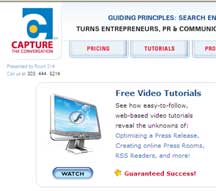
3. Online Tutorial Introduces You to Social Media (from my Tuesday, August 01, 2006 post). Capture the Conversation has posted on their web site a set of tutorials that are really cool. If you’re waiting for someone to show you how, you can stop waiting. These tutorials range from about three minutes to 10 and give you basic info on how to use a particular tool and why. Here are some related topics they’ve created tutorials for: How to Post a Comment on Blogs, Receiving Blog Trackbacks, Strategic Blog Commenting, Subscribing to a Blog via RSS Feed, and Setting Up a Technorati Account.
Next week, we’ll start a new topic: Podcasts!
As we wrap up this two-month lesson about blogs, I have listed some resources for you below. We spent two months on this topic because there is so much to cover. And we will actually come back to it later on to focus on blogger relations more specifically. The resources below are in no particular order.
1. "Introduction to Blogs" (I mentioned this one in a Friday, June 02, 2006, post)
The full title is: Introduction to Blogs: A quick guide to understanding and maximizing communication efforts in the blogosphere. This five-page document by Bacon’s Information Inc., discusses four reasons blogs have gained popularity, four general types of blogs, tips for working with blog writers, tips for monitoring the blogosphere, and tips using blogs as a marketing tool. While not being as comprehensive as some of the other resources I’ve found, this is a quick-read and good as an introduction (as the title indicates).
2. Waggener Edstrom Worldwide has several useful resources that I listed in a Monday, July 17, 2006, post, including: Are You Listening: Understanding the Blogosphere from a Communications Perspective (Part I) and Engaging the Blogosphere: Creating Connections and Fueling Conversations (Part II) (in pdf).
3. Online Tutorial Introduces You to Social Media (from my Tuesday, August 01, 2006 post). Capture the Conversation has posted on their web site a set of tutorials that are really cool. If you’re waiting for someone to show you how, you can stop waiting. These tutorials range from about three minutes to 10 and give you basic info on how to use a particular tool and why. Here are some related topics they’ve created tutorials for: How to Post a Comment on Blogs, Receiving Blog Trackbacks, Strategic Blog Commenting, Subscribing to a Blog via RSS Feed, and Setting Up a Technorati Account.
Next week, we’ll start a new topic: Podcasts!
Tuesday, March 27, 2007
2007 PRSA President Outlines Her Goals
Today, I had a chance to sit down to lunch with PRSA San Antonio's President for 2007 Fran Stephenson. I asked her about her goals for the organization as she serves in the role of president for 2007:
1. Building on the success of the Del Oro award program
2. Launching the Marilyn Potts Endowment Fund
3. Professional development and the strength of our programs
Listen to what she has to say in our first ever PRSA-SA Video Cast, maybe we will do more of these in the future:
1. Building on the success of the Del Oro award program
2. Launching the Marilyn Potts Endowment Fund
3. Professional development and the strength of our programs
Listen to what she has to say in our first ever PRSA-SA Video Cast, maybe we will do more of these in the future:
Tags:
Tuesday, March 13, 2007
Remember the Basics – Paying Attention to Avoid Going Up in Smoke
Locals are well aware of the pesky mulch fire just outside of San Antonio. The fire began on Christmas and still is burning. Officials have argued about who will pay the millions of dollars it is taking to put it out – before trying to put it out. Air quality experts have been arguing with water quality experts about which is more important. And the rest of us have been coughing and wheezing back and forth to the doctor. School children and local residents have even been relocated. Experts have been assembling from across the state.
During the same time, I’ve been painfully reminded that while learning about new media, you still have to tend to the old. Beginning at about the same time as the mulch fire, our chapter web site has been “under the weather” as well. The web-based editing tool we’d been using started having trouble, and the software company wanted us or our web host to by a service agreement before they would help fix the problem. Which of course we refused to do. So our web host has been looking for a new program and agreed to make our edits for us. But they’ve got bigger fish to fry and have kind-of forgotten about us. In the meantime, visitors in March were seeing promotions for an event in early February.
Wow, the local PR association can’t even keep its web site up to date. Just like the mulch fire, no one is at fault (except for the match-holder). But it can’t go on.
So this week, we set up a temporary web page using Google’s cool page builder tool, which is in beta, and set up a redirect.
We are also taking steps to create a whole new web site. This was actually already in the works, which is why we weren’t yelling at the web host to find new software faster. The new site should be ready in a couple of months. It will include new features like a directory of local PR firms, information on what our local PRSSA (student) chapter is up to at UTSA, and a section on our chapter’s community service.
It will also enable us to ramp up our blog to include basic tools like tagging and displaying photos. It’ll be like a breath of fresh air!
Sunday, March 11, 2007
Nominate a PR Professional in the San Antonio Area
You have four workdays left to nominate a colleague for a Del Oro Individual Award! The deadline for sending your nomination letter by email is the end of Thursday, March 15, 2007.
The Del Oro Awards are individual awards, recognizing leading public relations practitioners in the following areas:
• Tex Taylor Lifetime Achievement,
• Public Relations Professional of the Year,
• Community Service, and
• Horizon (recognizing a young PR professional "rising star").
There is no entry fee for the Del Oro individual awards. All it takes is a good letter of nomination! Details and entry guidelines are online at the chapter's web site.
If you feel someone you know is deserving, write down why and send in a nomination. Your colleague can't win otherwise!
The Del Oro Awards are individual awards, recognizing leading public relations practitioners in the following areas:
• Tex Taylor Lifetime Achievement,
• Public Relations Professional of the Year,
• Community Service, and
• Horizon (recognizing a young PR professional "rising star").
There is no entry fee for the Del Oro individual awards. All it takes is a good letter of nomination! Details and entry guidelines are online at the chapter's web site.
If you feel someone you know is deserving, write down why and send in a nomination. Your colleague can't win otherwise!
Thursday, March 08, 2007
Third Reason for Monitoring Blogs for Public Relations
Next installment of "Learning about Social Media from Your Desk"
The third reason in public relations to monitor blogs is to know what online conversations are related to your industry or company. In media relations, you probably report media coverage and group it by the event or whatever that started a set of coverage. But it pretty much stops there.
In this new world of social media, the number of blog posts is pretty trivial. It’s all about the conversation.
So when you are monitoring by post and tag searches and find relevant results, don’t think of them as a stream of unconnected mentions. Keep an eye on things like: the volume and content of comments, the links included in the post and the trackbacks (inbound links), and blog posts that mention other related blog posts. Go and track those links. Notice the direction of each conversation.
Then, you’ll need to decide when and how to join in the conversation. You can add comments to blog posts of the more influential bloggers. But do so judiciously. Do not try to sell something (even an idea). Be open about who you represent (this is really, really, really important). Express gratitude. Offer information. Gently provide corrections to errors.
Joining the conversation is important, but as a public relations professional, you have a special responsibility in how you go about it.
Sunday, March 04, 2007
Second Reason for Monitoring Blogs for Public Relations
Next installment of "Learning about Social Media from Your Desk" (I know it’s a new month, and we’re supposed to be moving to a new topic. But we’re going to stay on the topic of blogs for a bit.)
The second reason to monitor blogs is to know what certain bloggers are saying about your industry. To get started, you need to identify which bloggers you want to watch. By ego-surfing regularly, you may start to see which bloggers are focusing your topics of interest (pro, con or otherwise). You will also see which ones are most influential by virtue of them having a number of comments and inbound links.
Then you can go back to Technorati, Blogpulse and Google blog search (or others like Ask or Blogdigger as suggested by a commenter) to search for key terms. Be sure to search in “posts” and in “tags.” Searching in posts will give you a list of blog posts that use your term. That’s handy, but depending on how generic your terms are, you may get a list of irrelevant and random posts.
A tag is the key term that the blogger has assigned to his or her post. Usually there are a few tags per blog post. By searching in tags, you’ll see posts that are specifically about your term. Of course, you can subscribe to tag searches too. Over time, you’ll learn which terms give you the most useful results.
There are good reasons for searching posts and tags. For example, not every blog uses tags (like this one, due to software troubles). But start paying attention to tags. It’s one tool that makes social media so dynamic.
Sunday, February 25, 2007
First Reason for Monitoring Blogs for Public Relations – And a Word About Reporting
Next installment of "Learning about Social Media from Your Desk"
There are at least reasons in public relations to monitor blogs:
• To find blog posts that mention your company
• To know what certain bloggers are saying about your industry
• To know what online conversations related to your industry or company
The first is both the easiest and the most obvious. Plus, you can easily justify the time you may spend on it. The nickname for this is “ego-surfing.”
The most time-consuming way to do this would be to go to Technorati, Blogpulse and Google blog search (or others) a couple of times a day and search for posts that include your company’s name, your CEO or client’s name, and a key product or brand name.
But why would you do this when we’ve got the power of RSS at our fingertips?
You can actually go to these services and create a unique RSS feed for your specific search terms and have the results show up in your RSS feed reader.
1. Today’s homework is to set up some RSS searches for your organization. Listen to Bryan Person’s how-to NewCommRoad podcast episode, “Ego-surfing with RSS.” It’s only 14 minutes. It will pay off fast.
2. The next thing to figure out will be what to do with what you find. The answer will depend on your processes and the volume of results you get. This year, in addition to my reports of media coverage, I started providing a separate report of blog posts. There were lots of practical judgment calls I have faced. For example, when a relevant post is on an influential blog that has lots of comments, at what point do you print it out as your file copy? I decided to include in my reports posts that mention our story but are on blogs that aren’t related to our industry. I did this because we are interested in whether or not people are talking about a particular social issue, so it doesn’t matter whether the issue is the focus of their blog or not.
And forget about trying to measure audience sizes. You can’t possibly. And it isn’t relevant anyway. The more important factor is which bloggers are more influential. You’ll start to distinguish those as you monitor them.
Thursday, February 22, 2007
Online Searches of Media Coverage and Blog Posts Yield Varying Results
I was recently working on a report of media coverage for our board of directors. Thankfully, I don’t have to mess with column inches, gross impressions or any of those things. I just give them copies of articles and a list of coverage each quarter. This is the first time I have actually divided the report into “traditional media” and “social media” to distinguish and call attention to related blog conversations.
So that alone, I thought, was pretty hip. But there’s more to this story. It is well-known in the blogosphere that Google is the king of web site searching and Technorati is the queen of blog post searching.
But I’ve re-learned that there is value is using multiple sources.
I’d already set up Google’s cool alert feature to send me links to news articles that mention certain key words, like my organization’s name. But it misses a few here and there, so I also check Yahoo and Lexis.
A couple of months ago to monitor blog posts, I set up some Technorati searches that send results to me via RSS. Then each day, I checked and usually found no change – except for the story I shared with you recently.
But while I was working on my media report, on a whim, I decided to try Google’s blog search. Wow. I found a significant number of blog posts that I’d never seen.
Here’s my score card:
Number of articles in traditional news media identified by each search (January 2007)
Google Alerts = 5
Lexis search = 9
Google News search = 31
Yahoo News search = 32
Number of blog posts identified by each search (January 2007)
Technorati post search (via RSS) = 15
Technorati tag search = 1
Google Blog search = 30
Blogpulse search = 10
I am not promoting one service over another. In a different search, the results would be different I'm sure. I am simply grateful to these search services because I work for a non-profit and can’t afford the paid services (other than a mini-Lexis account). But neither can the average person in the social media space.
Sunday, February 18, 2007
Monitoring Blogs without Going Crazy
So by now, you’ve been reading several blogs. But if you’re doing so by remembering their URLs and going to each one individually, you soon learn that it takes way too much time. That’s what aggregators are for (made possible by RSS feeds, as we learned in January).
Some RSS readers, like the Google or Yahoo home page you set up last month are real handy. But there are better options for monitoring several blogs at once. These include: Bloglines, Blogpulse and quite a few more. I personally first tried using Technorati’s watch list, but it was not the right tool for this purpose.
So for this lesson, your homework is to set up a free account with one of these services to monitor blogs.
Then, when you see a blog you want to keep tabs on, you’ll subscribe to its feed. Each day or so, you can go to that service to see all the new headlines of the blogs you are monitoring. It’ll tell you which ones have new posts. Some will even show you the entire text of each blog post, so you can quickly scan the contents. At any time, you can click to view a particular blog in a new window (e.g., to leave a comment). There are also features to save blog posts as “clippings” to refer to later and to share your blog list with someone else.
Below are steps for setting up a Bloglines, only because it’s the one I know best.
• Go to www.bloglines.com.
• Sign up for a free account.
• Put a one-click subscribe button on your browser toolbar. (It’ll save you tons of time.) Click on “subscribe” and then click on “easy subscribe button.” Follow the instructions. I suggest putting this button on both your home computer and your work computer.
• Start subscribing to blogs.
• When you are ready to monitor, click on the “Feeds” tab.
There are other features to explore as you get more accustomed to the service.
Next time, we’ll talk about how to find blogs to monitor.
Tuesday, February 13, 2007
Two Free Webinars on Podcasting and Social Media
Give yourself a crash course.
Webinar: Podcasting 101 for Communicators and Marketers
Donna Papacosta, of the Trafcom News, is holding a free 45-minute webinar on podcasting. In her post announcing the webinar, she lists the following topics that will be covered:
• What podcasting is (and isn’t)
• How you can find podcasts pertinent to your interests
• How organizations are using podcasts for internal and external communications
• How podcasts are made
• How to sell the concept to your boss
• And much more.
“All you need are a phone and computer.”
The webinar will be held on Tuesday, February 20 at 2:00 Eastern. Send Donna an e-mail to see if there’s still space available for you. [date corrected CLG]
I never miss one of Donna’s podcasts. You will definitely learn something new and useful.
Social Media Webinar
Market Wire will be hosting several free social media webinars that will highlight general social media concepts as well as social media releases specifically. The webinars are free, but have limited space. Information is below.
■ Tuesday, March 13 at 10 a.m. PT / 1 p.m. ET
■ Thursday, March 15 at 11 a.m. PT / 2 p.m. ET
■ Tuesday, March 20 at 2 p.m. PT / 5 p.m. ET
E-mail Paul Dyer and indicate your first choice of date and time.
The Machine is Us/ing Us
One more cool thing… In her blog, Donna Papacosta directs us too a great online video that explains Web 2.0 and social media. In five captivating minutes digital ethnographers at Kansas State University demonstrate the development of the social media world. I am definitely going to be sharing this with my co-workers. Watch The Machine is Us/ing Us now!
Webinar: Podcasting 101 for Communicators and Marketers
Donna Papacosta, of the Trafcom News, is holding a free 45-minute webinar on podcasting. In her post announcing the webinar, she lists the following topics that will be covered:
• What podcasting is (and isn’t)
• How you can find podcasts pertinent to your interests
• How organizations are using podcasts for internal and external communications
• How podcasts are made
• How to sell the concept to your boss
• And much more.
“All you need are a phone and computer.”
The webinar will be held on Tuesday, February 20 at 2:00 Eastern. Send Donna an e-mail to see if there’s still space available for you. [date corrected CLG]
I never miss one of Donna’s podcasts. You will definitely learn something new and useful.
Social Media Webinar
Market Wire will be hosting several free social media webinars that will highlight general social media concepts as well as social media releases specifically. The webinars are free, but have limited space. Information is below.
■ Tuesday, March 13 at 10 a.m. PT / 1 p.m. ET
■ Thursday, March 15 at 11 a.m. PT / 2 p.m. ET
■ Tuesday, March 20 at 2 p.m. PT / 5 p.m. ET
E-mail Paul Dyer and indicate your first choice of date and time.
The Machine is Us/ing Us
One more cool thing… In her blog, Donna Papacosta directs us too a great online video that explains Web 2.0 and social media. In five captivating minutes digital ethnographers at Kansas State University demonstrate the development of the social media world. I am definitely going to be sharing this with my co-workers. Watch The Machine is Us/ing Us now!
Wednesday, February 07, 2007
Lesson Two: Get Acquainted with the Blogs
In this lesson, we will explore several blogs related to public relations and communications as a way of learning more about social media. We will also learn how to monitor blog conversations related to your organization, client or industry. Later on in the year, we’ll expand on all this. I am not going to suggest that you start a blog at this time (if ever). So you can breathe now.
First, let’s talk about what blogs are in the first place. A blog is a type of web site. It uses some kind of blogging software to operate. You can use blogging software for other purposes as well without actually having a blog. So what makes a blog a blog. There’s some debate about this, but most I think would agree that a blog has these elements:
• Blog posts appear in reverse chronological order, with the most recent at the top.
• Blogs use RSS to send their headlines to people who want them.
• Most blogs enable comments to be made by visitors. Some bloggers chose to moderate those comments before they show up on the blog.
• Most blogs use tagging to help people find their content. Tagging is another term for keywords. When a blogger writes a post, he or she assigns certain keywords to indicate what the post is about. Readers who search for one of those terms will find the blog post.
Those are the structural elements. The main difference between a web site and a blog from an organizational standpoint is that a web site is the formal “official voice” of the organization and a blog is typically opinion, informal and conversational. Web sites are written by organizations, blogs are written by individuals. The result is that blogs invite two-conversation rather than the “traditional” one-way speak.
From a PR perspective, blogs can serve quite a number of communication purposes. Primarily, they can help you engage your key audiences. They can help you tell your story. They can be used to exchange ideas and learn ways to improve your products, services, etc. They can be used in a crisis to exchange information fast without having to fit it into your main web site’s structure. They can help you learn what your publics are thinking and what they care about. And much more.
Homework
If you’re reading this, you’ve obviously read at least one blog. I have a list of a few others that you might want to visit. But I’d really like to know what blogs you like best. Leave a comment and let other readers know too.
(in alpha order)
A Shel of My Former Self, by Shel Holtz
http://blog.holtz.com/
Bryper.com, by Brian Person
http://www.bryper.com/
Communication Overtones, by our own Kami Huyse, APR
http://overtonecomm.blogspot.com/
Disruptive Conversations, by Dan York
http://www.disruptiveconversations.com/
Forward Blog, by a group of students, faculty and professionals
http://www.forward-moving.com/blog/
NevilleHobson.com, by Neville Hobson
http://www.nevillehobson.com/
Trafcom News, by Donna Papacosta
http://trafcom.typepad.com/blog/
Thursday, February 01, 2007
Exploring Newsfeeds and Webfeeds
Lesson One Review – Learning About Social Media from Your Desk
So, we’ve reached the end of our first lesson in “Learning About Social Media from Your Desk.” In January, we learned a bit about using RSS (“indoor plumbing of Web 2.0”). How did you do? Leave a comment and tell about what you tried, questions you had or still have, or what you learned. It’ll help others.
In case you are among those who just found out about this tutorial, below is a review of this month’s lesson.
1. Lesson One – Learning About Social Media from Your Desk (January 04, 2007) Explore Newsfeeds and Webfeeds
First assignment: Set up either a Yahoo personal page or a Google personal page. And select at least three RSS feeds to watch over the course of this month.
2. More Learning about RSS (January 16, 2007)
Ideas for RSS feeds to subscribe to and a link to a video that shows you how to subscribe to a feed.
3. Using RSS in PR (January 22, 2007)
Extra Credit: Subscribe to specific search terms through Technorati.
4. Don’t Limit RSS to Receiving Information, Use RSS to Send Info Too (January 28, 2007)
Four ways to use RSS to send information.
Stay tuned for our second lesson coming soon…
Sunday, January 28, 2007
Don’t Limit RSS to Receiving Information, Use RSS to Send Info Too
If you are a blogger or podcaster, you depend on your outgoing RSS feeds to notify folks of your work. But that’s not all. There are many reasons to set up outgoing RSS feeds on your organization or client's web site. At a minimum, RSS feeds can notify folk when you’ve changed your web site content. Here are some other uses.
Use RSS feeds to distribute news releases rather than distributing by e-mail. E-mail releases have lots of trouble getting past spam filters and standing out from the crowd. But with RSS, the reporter knows he or she has asked for your information.
Use RSS feeds in place of e-mail newsletters. Many experts are predicting that e-mail newsletters are on their way out. It’ll take a year or two as people become more accustomed to using RSS feeds. But when that happens, no one will want newsletters cluttering their inboxes. I’m so glad, because finding software or services for distributing e-mail newsletters that won’t get caught up in spam filters is a huge pain.
Create relevant resource information for your web site visitors and send it out regularly through RSS feed. You can provide a dependable service, while at the same time keeping your name in front of potential clients. Plus, you’ll drive additional relevant traffic to your site.
Use RSS to reach publics through new means like cell phones, PDAs and mp3 players. If these are the primary tools your publics use, then RSS helps you reach them.
Use RSS feeds to distribute news releases rather than distributing by e-mail. E-mail releases have lots of trouble getting past spam filters and standing out from the crowd. But with RSS, the reporter knows he or she has asked for your information.
Use RSS feeds in place of e-mail newsletters. Many experts are predicting that e-mail newsletters are on their way out. It’ll take a year or two as people become more accustomed to using RSS feeds. But when that happens, no one will want newsletters cluttering their inboxes. I’m so glad, because finding software or services for distributing e-mail newsletters that won’t get caught up in spam filters is a huge pain.
Create relevant resource information for your web site visitors and send it out regularly through RSS feed. You can provide a dependable service, while at the same time keeping your name in front of potential clients. Plus, you’ll drive additional relevant traffic to your site.
Use RSS to reach publics through new means like cell phones, PDAs and mp3 players. If these are the primary tools your publics use, then RSS helps you reach them.
Wednesday, January 24, 2007
What Trends Can PR Students Expect to Learn From in 2007?
As an undergraduate student preparing to enter the profession of public relations, I am learning some of the trends that we can expect to see in 2007 and how it affects students like me. I am a subscriber to the Bulldog Reporter's Daily Dog blog, and I read an important op-ed piece by Howard J. Rubenstein, Founder, Rubenstein and Associates.
In this op-ed piece Rubenstein discusses eight trends and predictions to be watched and planned for this year. I would like to take these and give them a spin from a student’s perspective.
1. Greater importance will be placed on the public relations professional. For an undergraduate, who is anticipating graduation in May or Dec., this means that through proper practice in the discipline through internships and curriculum assignments they will have a greater chance to land that all important first job. In turn that first job will serve a greater purpose by instilling an individual sense of importance in the new PR professional.
2. Greater emphasis on high ethical standards will become the norm. It will be extremely important for undergraduates to be given the tools to increase their understanding of the importance of high ethical standards. In my PR class we briefly touched upon the PRSA Member Code of Ethics. As a student and aspiring PR professional, I felt that there should more emphasis on the topic of ethics, especially in light of so many of the high-ranking individuals being forced from positions or going to jail because of their lack of ethics.
3. Globalization of communications will continue. It is evident that countries such as China and India have emerged as huge players in the marketplace.Undergraduate students have to take upper level support work classes, mine are Introduction to Marketing and Advertising. I chose the same professor for both, Dr. Richard L. Utecht and one of the six steps to be successful as a new professional he suggests is to become internationalized. What he means is to learn not only different languages but to learn different cultures to prepare for those opportunities that may arise.
4. U.S. cities will start to feel the strain of a weakening economy. For an undergraduate student who has lived in a specific city their entire life and attends college in their city, this will be a huge benefit. I say this because the student has seen the ups and down of how the city has promoted itself to their state and the country, especially if the city is a tourist destinations like San Antonio. The new professional who decides to stay in their city can play an integral part in working to improve their city’s image through innovative PR tactics.
5. More students will study communication and PR. When I entered San Antonio College I wanted to study journalism because I love to write, however I was not willing to relocate to a university that offered a great journalism curriculum. Because of this I transferred to the University of Texas at San Antonio (UTSA). I chose UTSA due to its nationally recognized communication curriculum as well as a recognized PR concentration. Because of this status the enrollment in the communication program in the PR concentration at UTSA is increasing every year and I would be willing to agree that this will be the case across the world.
6. Blogging will continue to win PR attention and resources. Bloggers will continue to influence people in their choices and how they receive their information. Blogging will also continue to grow as a PR tool which will be a plus for the tech-savvy younger generation. When I began as the student blogger for the San Antonio: Byline Blog I had never participated in the phenomenon of blogging. Now, although I do not post as often as I should, I love the fact I have a place here.
7. Face-to-face networking will thrive despite online advances. For the undergraduate aspiring to be a PR professional; face-to-face networking will be huge. One of the greatest benefits for me as the Chapter President of the PRSSA Chapter at UTSA is being able to attend the PRSA Chapter of San Antonio's monthly luncheon. Our Chapter has gained so much because of our attendance at these luncheons. In fact my blogging opportunity came about because I attended a luncheon, and a previous writing sample.
8. PR will enjoy new opportunities to help restore our national image. For the undergraduate who is looking to enter the PR profession with an emphasis in politics or emphasis on the image of our nation this may be true. During the next year as we continue on the road to the 2008 elections there will be plenty of opportunities for the aspiring PR professional to be front and center. Politicians and their handlers are always going to be looking for PR professionals that can help present the right image to the youngest voters in the nation. Not only in this instance, but as a whole our nation will be looking to improve its image across the globe.
I would be interested in hearing your thoughts regarding my own observations on how these eight trends will affect the undergraduate aspiring to enter the PR profession.
In this op-ed piece Rubenstein discusses eight trends and predictions to be watched and planned for this year. I would like to take these and give them a spin from a student’s perspective.
1. Greater importance will be placed on the public relations professional. For an undergraduate, who is anticipating graduation in May or Dec., this means that through proper practice in the discipline through internships and curriculum assignments they will have a greater chance to land that all important first job. In turn that first job will serve a greater purpose by instilling an individual sense of importance in the new PR professional.
2. Greater emphasis on high ethical standards will become the norm. It will be extremely important for undergraduates to be given the tools to increase their understanding of the importance of high ethical standards. In my PR class we briefly touched upon the PRSA Member Code of Ethics. As a student and aspiring PR professional, I felt that there should more emphasis on the topic of ethics, especially in light of so many of the high-ranking individuals being forced from positions or going to jail because of their lack of ethics.
3. Globalization of communications will continue. It is evident that countries such as China and India have emerged as huge players in the marketplace.Undergraduate students have to take upper level support work classes, mine are Introduction to Marketing and Advertising. I chose the same professor for both, Dr. Richard L. Utecht and one of the six steps to be successful as a new professional he suggests is to become internationalized. What he means is to learn not only different languages but to learn different cultures to prepare for those opportunities that may arise.
4. U.S. cities will start to feel the strain of a weakening economy. For an undergraduate student who has lived in a specific city their entire life and attends college in their city, this will be a huge benefit. I say this because the student has seen the ups and down of how the city has promoted itself to their state and the country, especially if the city is a tourist destinations like San Antonio. The new professional who decides to stay in their city can play an integral part in working to improve their city’s image through innovative PR tactics.
5. More students will study communication and PR. When I entered San Antonio College I wanted to study journalism because I love to write, however I was not willing to relocate to a university that offered a great journalism curriculum. Because of this I transferred to the University of Texas at San Antonio (UTSA). I chose UTSA due to its nationally recognized communication curriculum as well as a recognized PR concentration. Because of this status the enrollment in the communication program in the PR concentration at UTSA is increasing every year and I would be willing to agree that this will be the case across the world.
6. Blogging will continue to win PR attention and resources. Bloggers will continue to influence people in their choices and how they receive their information. Blogging will also continue to grow as a PR tool which will be a plus for the tech-savvy younger generation. When I began as the student blogger for the San Antonio: Byline Blog I had never participated in the phenomenon of blogging. Now, although I do not post as often as I should, I love the fact I have a place here.
7. Face-to-face networking will thrive despite online advances. For the undergraduate aspiring to be a PR professional; face-to-face networking will be huge. One of the greatest benefits for me as the Chapter President of the PRSSA Chapter at UTSA is being able to attend the PRSA Chapter of San Antonio's monthly luncheon. Our Chapter has gained so much because of our attendance at these luncheons. In fact my blogging opportunity came about because I attended a luncheon, and a previous writing sample.
8. PR will enjoy new opportunities to help restore our national image. For the undergraduate who is looking to enter the PR profession with an emphasis in politics or emphasis on the image of our nation this may be true. During the next year as we continue on the road to the 2008 elections there will be plenty of opportunities for the aspiring PR professional to be front and center. Politicians and their handlers are always going to be looking for PR professionals that can help present the right image to the youngest voters in the nation. Not only in this instance, but as a whole our nation will be looking to improve its image across the globe.
I would be interested in hearing your thoughts regarding my own observations on how these eight trends will affect the undergraduate aspiring to enter the PR profession.
Monday, January 22, 2007
Using RSS in PR
If you are participating in our Learn About Social Media from Your Desk project, you by now have been become familiar with RSS feeds. But the question may remain: Why is RSS important for public relations?
A key advantage of RSS for PR is the same as it is for other folk. It puts you in control. You decide what news you receive. You decide which conversations to monitor. You don’t have to remember to check dozens of web sites regularly to see what’s changed. And you are dealing online rather than with managing your e-mail inbox.
For public relations this means you can monitor news, trends and conversations that affect your clients or organization.
Let me give you an example. A couple of months ago, I set up some search terms in Technorati and subscribed to them. Those terms include the name of my organization and our executive director’s name. Whenever something new shows up in a blog that uses one of those terms, it shows up in my Google home page. Last week, there was a mention in a blog that I hadn't seen before. It happens to be authored by a reporter who has interviewed our director several times over the years. We have a good relationship, but I hadn’t noticed that he has a blog now. I went to his blog post that mentions us and left a comment praising his blog and mentioned that we have a podcast now. He blogged about the podcast the next day. If I hadn’t been using RSS feeds to monitor blog posts, this wouldn’t have happened.
Josh Hallett of the Hyku Blog offers this brief A Guide To Media Monitoring With RSS.
Extra Credit
Subscribe to specific search terms through Technorati. To find out how, listen to Bryan Person’s podcast, Ego-surfing with RSS. It’s very easy and won’t take long.
Next time, we’ll talk about how you can use RSS to distribute news.
Thursday, January 18, 2007
Social Media Technology Quickstart - A Beginner's Webinar
Shannon Whitley is hosting a free webinar next Wednesday. This is a very basic introduction to social media technologies for PR professionals. Below are details.
Date: Jan 24, 2007
Time: 10:00 am - 11:00 am (Pacific)
Location: Webinar
Limit: 20 attendees
You're a PR professional and you know you need to figure out this 'social media stuff,' but you've been waiting for the right time. Still, your clients are starting to ask about the blogosphere and multimedia press releases. You can't afford to put it off any longer.
Shannon Whitley, the creator of PRX Builder, will help you take your first steps into the world of social media. Learn the basics through a one-hour introduction and prepare yourself for your clients' next round of technology questions.
More information and online registration are available here
Date: Jan 24, 2007
Time: 10:00 am - 11:00 am (Pacific)
Location: Webinar
Limit: 20 attendees
You're a PR professional and you know you need to figure out this 'social media stuff,' but you've been waiting for the right time. Still, your clients are starting to ask about the blogosphere and multimedia press releases. You can't afford to put it off any longer.
Shannon Whitley, the creator of PRX Builder, will help you take your first steps into the world of social media. Learn the basics through a one-hour introduction and prepare yourself for your clients' next round of technology questions.
More information and online registration are available here
Wednesday, January 17, 2007
Vista Blogger Campaign Misses Opportunity
Microsoft’s recent blogger relations campaign has created quite a stir. Here’s the quick background: With the help of PR agency, Edelman, Microsoft sent valuable laptops with the new Vista operating system to targeted influential bloggers. Segments included the obvious technology bloggers, but also parenting bloggers and Mac-lovers. This was a no-strings-attached kind of deal. No requirement to blog about Vista. Originally, the bloggers were not asked to return the laptops or to disclose anything in their blog posts. Apparently, some of the recipients have no idea why they were chosen to receive this “gift.”
Much of the debate has focused on the ethics involved: Was this a gift rather than a loaner for review (as would have been done with journalists)? Was it a bribe? Should bloggers be required to disclose the situation?
It’s been a healthy debate.
I personally don’t have a problem with the laptop distribution, but I believe mistakes were made in the planning and execution. As a result, much of the blogger debate has been on the campaign rather than on the merits of the product.
What I’m wondering is: What was Microsoft’s goal for this Vista blogger relations campaign? How are they measuring success?
There are lots of things they can be counting:
• Number of blog posts that mention Vista.
• Number of blog posts related to Vista by targeted bloggers.
• Number of positive blog posts that mention Vista.
• Number of negative blog posts that mention Vista.
• Number of blog posts related to Vista that don’t use the name Vista.
• Number of blog posts related to Vista that don’t use the name Microsoft.Number of blog posts related to Vista that only use the name Edelman.
• Etc., etc.
I’m sure Microsoft and Edelman are pretty sophisticated with this stuff and that what they are measuring is directly related to their goal, which likely is purchases of Vista. But what was the goal of their blogger relations portion of the campaign? They’re not looking for input into how to make Vista better since that occurred during the beta phase. They may have been listening for how bloggers describe certain features so they can incorporate that language into their marketing.
But I suspect a main goal was simply to generate awareness. There are lots of Windows users who have no idea what Vista is or that it’s coming soon. I generally avoid campaigns that are limited to awareness, but for someone as big as Microsoft, awareness may be all it takes for many consumers to spend some money.
Ironically, by counting an increase in blog posts and comments this month about Vista, Microsoft could rule this campaign a success. That would be a mistake.
They’ve missed a big opportunity. Lack of awareness isn’t the only barrier to OS or software adoption. Perceptions of bugs and compatibility troubles are a huge barrier. Many of these issues have been blogged about during the beta phase. Even if the issues have been resolved in the final release version, the blog posts are still out there. Other concerns are based solely on rumor. Plus, Microsoft has been our main teacher of the lesson that it’s dangerous to install the first version of anything.
Here was an opportunity to initiate a conversation that would dispel myths and resolve concerns that are keeping individuals and businesses from buying this product. Awareness would grow as well.
So how could Microsoft and Edelman have done this blogger relations campaign in a way that addressed these consumer concerns?
Tuesday, January 16, 2007
More Learning about RSS
Still working on your homework? Here are some ideas for RSS feeds to subscribe to just to get in the habit.
Word Wise – Writing tips for public relations professionals, and for people everywhere,
35 Ways You Can Use RSS Today by Steve Rubel
And here’s a good article on working with RSS: Untangle the World Wide Web with RSS
Plus, Kami commented on one of our recent assignments great link to a video that shows you how to subscribe to a feed.
Word Wise – Writing tips for public relations professionals, and for people everywhere,
35 Ways You Can Use RSS Today by Steve Rubel
And here’s a good article on working with RSS: Untangle the World Wide Web with RSS
Plus, Kami commented on one of our recent assignments great link to a video that shows you how to subscribe to a feed.
Thursday, January 11, 2007
Man Bites Dog: Get Weekly Reports of the Top U.S. News Stories
If you’re interested in monitoring the news, here’s a great resource for you. This week, the Project for Excellence in Journalism launched a weekly New Coverage Index that reports which stories got the most coverage in the United States from more than 40 media outlets, including print, network television, cable, online and radio.
According to the index, last week’s top news story was Nancy Pelosi's swearing in as the first female Speaker of the House. Other top stories were Gerald Ford's funeral, the policy debate in Iraq, and Saddam Hussein’s hanging.
Each report though, comes with an impressive analysis and details by media channel. What’s really cool is you can sign up to have the index sent to you by RSS feed or by e-mail each week. You can also see the list of top 10 stories by percent for each medium.
The web site announces that there is even more to come:
“In the weeks that follow, PEJ will also unveil a series of secondary indices, including People in the News; a Talk Show Index from cable and radio programming; and a Blogger Index examining the content of the blogosphere and analyzing how it compares with that of the mainstream media.”
I wish the Tyndall Report provided RSS feeds too! (Since 1987, Tyndall has been monitoring coverage by U.S. nightly newscasts.)
If you are participating in our assignments to “Learn About Social Media from Your Desk,” the News Coverage Index could be one of the three RSS feeds in your homework assignment.
Thursday, January 04, 2007
Lesson One – Learning About Social Media from Your Desk
Introduction
I’ve talked with several of my public relations colleagues who say they’ve been meaning to learn about social media (blogs, podcasts, social networking, etc.). They just haven’t found the time yet.
When something is important, you make time for it. And one thing I have learned this last year is that this is really important to our profession.
The purpose of this PRSA San Antonio Byline blog from the beginning was to help PR professionals learn about this new world. We are now going to step it up a notch. While there are many other places you can go for a crash course or to learn from real experts, we are going to provide bite-size activities to help folk who are interested learn over time without having to drop all their other work.
Please join in. No one has to know. But I hope you will share ideas, discoveries and questions along the way.
1. Explore Newsfeeds and Webfeeds
Our first step is to learn about RSS (aka, newsfeeds and webfeeds). RSS is the technical term for what has made all this social media stuff even possible. RSS is the indoor plumbing of Web 2.0. There is a lot of engineering behind indoor plumbing, but you don’t have to understand it to get a glass of water. You control whether the water comes out of kitchen faucet or the shower. And you don’t have to go to the source when you want hot water instead of cold.
The same is true with RSS. Headlines, etc., come to you. You don’t have to remember to check 100 individual web sites any more.
So here’s your first assignment: Set up either a Yahoo personal page or a Google personal page. And select at least three RSS feeds to watch over the course of this month.
There are several resources to help you learn about RSS. The first one I am going to suggest is that you listen to a certain episode (Learning about RSS) of the New Comm Road podcast by Bryan Person because it also walks you through setting up a Yahoo personal page. It’s only 20 minutes. Even if you have an iPod or mpg player, I recommend that you listen to this podcast from your desk so you can go through the steps while you listen. If you’d rather create a Google page, the steps are very similar.
The next step will be to select some RSS feeds to monitor. You can start with the feed from this blog. Click on the orange button at the right. Then click on the My Yahoo button or the Add to Google button. I’ll have more RSS suggestions and resources in my upcoming posts.
That’s it for today. Let me know how it’s going.
I’ve talked with several of my public relations colleagues who say they’ve been meaning to learn about social media (blogs, podcasts, social networking, etc.). They just haven’t found the time yet.
When something is important, you make time for it. And one thing I have learned this last year is that this is really important to our profession.
The purpose of this PRSA San Antonio Byline blog from the beginning was to help PR professionals learn about this new world. We are now going to step it up a notch. While there are many other places you can go for a crash course or to learn from real experts, we are going to provide bite-size activities to help folk who are interested learn over time without having to drop all their other work.
Please join in. No one has to know. But I hope you will share ideas, discoveries and questions along the way.
1. Explore Newsfeeds and Webfeeds
Our first step is to learn about RSS (aka, newsfeeds and webfeeds). RSS is the technical term for what has made all this social media stuff even possible. RSS is the indoor plumbing of Web 2.0. There is a lot of engineering behind indoor plumbing, but you don’t have to understand it to get a glass of water. You control whether the water comes out of kitchen faucet or the shower. And you don’t have to go to the source when you want hot water instead of cold.
The same is true with RSS. Headlines, etc., come to you. You don’t have to remember to check 100 individual web sites any more.
So here’s your first assignment: Set up either a Yahoo personal page or a Google personal page. And select at least three RSS feeds to watch over the course of this month.
There are several resources to help you learn about RSS. The first one I am going to suggest is that you listen to a certain episode (Learning about RSS) of the New Comm Road podcast by Bryan Person because it also walks you through setting up a Yahoo personal page. It’s only 20 minutes. Even if you have an iPod or mpg player, I recommend that you listen to this podcast from your desk so you can go through the steps while you listen. If you’d rather create a Google page, the steps are very similar.
The next step will be to select some RSS feeds to monitor. You can start with the feed from this blog. Click on the orange button at the right. Then click on the My Yahoo button or the Add to Google button. I’ll have more RSS suggestions and resources in my upcoming posts.
That’s it for today. Let me know how it’s going.
Wednesday, January 03, 2007
Learn About Social Media from Your Desk
How do you eat an elephant?
One bite at a time.
The same is true for learning about social media and its uses for public relations. Make a New Year’s resolution to watch this PRSA chapter blog for monthly simple assignments designed to introduce PR professionals to different facets of new media (blogs, podcasts, wikis, etc.).
During the first week of each month, there will be a new “assignment” that can be done in less than an hour. Throughout the month, extra credit assignments will be posted.
And the best part is that there are no grades and nothing to turn in.
One bite at a time.
The same is true for learning about social media and its uses for public relations. Make a New Year’s resolution to watch this PRSA chapter blog for monthly simple assignments designed to introduce PR professionals to different facets of new media (blogs, podcasts, wikis, etc.).
During the first week of each month, there will be a new “assignment” that can be done in less than an hour. Throughout the month, extra credit assignments will be posted.
And the best part is that there are no grades and nothing to turn in.
Tuesday, January 02, 2007
Where's Gregory?
Where's Gregory? This has been such an incredible holiday season that began right after my return from the 2006 PRSSA National Conference on Nov. 14. While I was in Salt Lake City, I was only able to post here twice. I was having serious issues with my laptop. I was able to attend some excellent sessions including the Roll Call breakfast with Keynote Speaker Richard Edelman, president and chief executive officer, Edelman Public Relations.
Edelman discussed the evolution of the horizontal axis of communications currently complementing the traditional top down vertical axis. It is considered the democratization of information. Edelman continued by discussing what is called the Me2 Revolution. This is the process of peers relying in a web of trust of other peers. He noted that Edelman's Trust Barometer 2006 showed that 68% of individuals felt the most credible source of information in the US was from a "person like myself." He pointed to the fact that more large companies like Microsoft are relying on their employees as their best source of PR in conjuction with their PR department. But he also pointed to the fact that this can also backfire as is the case with Delta by their inability to adapt to this horizontal axis and found themselves the subject of "DeltaReallySucks.com."
I found it extremely interesting the current trends that are shaping the newspaper and weekly magazine publishers. These publishers are losing advertising money left and right due to the desire of audiences to have a more imediacy in what they read, watch and listen.Newsweek now shares it's content on Facebook in an effort to reach a younger audience. Business Week now places 46% of its content online compared to 33% in 2005. Similar changes are underway in network television broadcasting. Currently 300,000 people download the ABC Nightly News via I-Tunes each week. Social media is a force to be reckoned with for many businesses that continue to struggle with adaptation to the concept. I will continue more on this session in another post soon.
Okay, so I got off on a tangent. The PRSSA Chapter at UTSA held elections for a new Executive Board on Nov. 30 and I am excited to announce that I have been re-elected as President. I am excited to begin the new year with nine other highly motivated individuals and continue working on all of the great things we began over hte last eight months. On a personal note my partner and I closed on a house on December 19 and will be moving around the first week in Feb. So as you can see the last few weeks have been very exciting and busy for me. I will work harder to post more often.
Edelman discussed the evolution of the horizontal axis of communications currently complementing the traditional top down vertical axis. It is considered the democratization of information. Edelman continued by discussing what is called the Me2 Revolution. This is the process of peers relying in a web of trust of other peers. He noted that Edelman's Trust Barometer 2006 showed that 68% of individuals felt the most credible source of information in the US was from a "person like myself." He pointed to the fact that more large companies like Microsoft are relying on their employees as their best source of PR in conjuction with their PR department. But he also pointed to the fact that this can also backfire as is the case with Delta by their inability to adapt to this horizontal axis and found themselves the subject of "DeltaReallySucks.com."
I found it extremely interesting the current trends that are shaping the newspaper and weekly magazine publishers. These publishers are losing advertising money left and right due to the desire of audiences to have a more imediacy in what they read, watch and listen.Newsweek now shares it's content on Facebook in an effort to reach a younger audience. Business Week now places 46% of its content online compared to 33% in 2005. Similar changes are underway in network television broadcasting. Currently 300,000 people download the ABC Nightly News via I-Tunes each week. Social media is a force to be reckoned with for many businesses that continue to struggle with adaptation to the concept. I will continue more on this session in another post soon.
Okay, so I got off on a tangent. The PRSSA Chapter at UTSA held elections for a new Executive Board on Nov. 30 and I am excited to announce that I have been re-elected as President. I am excited to begin the new year with nine other highly motivated individuals and continue working on all of the great things we began over hte last eight months. On a personal note my partner and I closed on a house on December 19 and will be moving around the first week in Feb. So as you can see the last few weeks have been very exciting and busy for me. I will work harder to post more often.
Saturday, December 30, 2006
Like Construction Tools, Blogging Can be Dangerous to the Unprepared
Much has been written about the benefits of businesses getting into blogging. To some, it seems like a no brainer, like it should be an automatic part of your PR arsenal. If you’re not blogging, you’re among those who don’t “get it.”
Others who frankly are more in touch with the purposes of public relations know that blogging is one tool in a large toolbox. And each tool has its function. Nothing new there. But new tools can be dangerous when you don’t know how to use them. That’s a big reason more companies haven’t entered this arena. They’ve seen just how a mistake can turn into a nightmare.
Before you convince a client or your organization to dive into blogging, do some homework. Do lots of homework. Read blogs. Watch trends. Engage with bloggers. Set goals for specific audiences or stakeholders. Learn from others’ creativity and learn from others’ mistakes.
There is tons of potential in the blogosphere to turn around an issue, a business or even an industry. But faking it won’t work. Ethics aside for a moment, what may have been possible in other media, just isn’t in this one.
Noelle Weaver of Advertising Age has a great post, “What we should learn from Sony’s fake blog fiasco,” that discusses false marketing practices. There are many great resources online and off about how to blog effectively. But Noelle shares four lessons that are deeper than a how-to.
1. “Good advertising doesn’t rely on tricking, lying to or deceiving your target
audience.”
2. “The consumer is smarter than you think, alternative marketing
tactics must be genuine, authentic and in today’s world, transparent.”
3.
“Today’s interest in brand politics means that everything you do will come under
scrutiny from someone. See number 2.”
4. “Involve your consumer in the brand
conversation, give them the tools to do so and they will repay you four-fold.”
The real homework has nothing to do with the technology. As I’ve said before, for many this is a different kind of strategy.
Thursday, December 14, 2006
Planning Your Podcast Series
My organization has launched a podcast series designed for one of our specific audiences. We kicked it off in October and have several episodes under our belt. I thought it might be useful for others if I shared the outline of the planning document I prepared in advance for my directors. I did not have to sell them on the idea of podcasting, but I did have to map out a plan for how to get there. The text that followed each heading or subheading was no more than one paragraph (except for the list of related existing podcasts).
- Goal (big picture, does not mention podcasting)
- Strategy
- Objectives
- Tactic (This is where podcasting is first mentioned. e.g., Produce a podcast series [when] targeted to [who].)
- Benefits
a. Benefits of Podcasting (adapted slightly from Eric Schwartzman’s list April 18, 2006 post – thanks Eric!)
b. Benefits of Podcasting for my organization - Details and Next Steps
a. Frequency
b. Sponsored by which internal project(s)
c. Planned Topics and Schedule
d. Staff Roles
e. Equipment Needs (recording equipment, software, feedback mechanisms, web site)
f. Preparation Timeline
g. Policy Statements and Licenses (copyright, privacy policy, release form, music licenses)
h. What do we call our podcast?
i. Style
j. Program Format and Length
k. Production Process
l. Feedback
m. Sample Introduction Segment - Promotion
- Measurement
- Other Related Podcasts (topical list from Podcast Alley)
Before I started writing my plan, I did some research by listening to PR and communications related podcasts and by participating in a webinar held by Shel Holtz. I also referred to the excellent book, Podcast Solutions by Michael Geoghegan and Dan Klass.
Once the plan was finished, we decided to deal with the technical learning curve by hiring a consultant to do the production portion, Byran Person. After we record each episode (on a $150 pocket-size digital recorder), he edits the audio, adds intros, etc. He also has advised us on several aspects of the process. We are very grateful for his assistance.
For any organization that is planning to start a podcast series and doesn’t have the expertise inhouse, I highly recommend taking this route. There are several very qualified folk who can provide this kind of assistance, and it doesn’t matter where in the world they live.
Friday, December 01, 2006
Read and Listen to Coverage from the PRSA Conference
PRSA’s International Conference is over, but if you couldn’t attend, there are a number of bloggers that covered parts of the conference, and Webmaster radio has a series of MP3s of some of the sessions and of some interviews.
And, better yet, all of the information is free!
I was thrilled to hear the entire session with Andrew Heyward, former president of CBS News, who spoke about the changes in the Digital World (MP3) and why PR practitioners should care. Heyward should know since it was in his tenure that 60 Minutes aired the program that about President Bush’s National Guard service using documents that turned out to be falsified. An outcry from bloggers forced CBS to take a closer look at this incident. Heyward talks about his in his keynote.
In the Webmaster radio list, there is also an interview with Katie Payne, who will be in Austin next week to talk about measurement of internal programs. A few of us are driving up togehter to attend and will post something about the meetup on this blog.
Lauren Vargas has a list of some of the better posts from the conference and other resources. I particularly liked Katie Payne’s post about repairing America’s image abroad.
Happy reading and listening!
And, better yet, all of the information is free!
I was thrilled to hear the entire session with Andrew Heyward, former president of CBS News, who spoke about the changes in the Digital World (MP3) and why PR practitioners should care. Heyward should know since it was in his tenure that 60 Minutes aired the program that about President Bush’s National Guard service using documents that turned out to be falsified. An outcry from bloggers forced CBS to take a closer look at this incident. Heyward talks about his in his keynote.
In the Webmaster radio list, there is also an interview with Katie Payne, who will be in Austin next week to talk about measurement of internal programs. A few of us are driving up togehter to attend and will post something about the meetup on this blog.
Lauren Vargas has a list of some of the better posts from the conference and other resources. I particularly liked Katie Payne’s post about repairing America’s image abroad.
Happy reading and listening!
Tags:
Subscribe to:
Posts (Atom)