Thursday, March 30, 2006

Blogfree Companies in San Antonio

In my last post, I wondered how many companies in San Antonio have entered the blog world. I decided to see for myself.

First let me explain the process I used. Disclaimer #1: I selected the top 10 San Antonio Area Publicly Traded Companies as listed by the San Antonio Business Journal in late 2005. I did not look at more than 10 or at any private companies. Disclaimer #2: I used Google to find their web sites and checked the contact info to make sure I had the right company. Disclaimer #3: I reviewed the home page and some pages that were only one click away from the home page. I did not investigate every page. I spent about two minutes per site -- because I have a life to get on with.

Here are the companies I reviewed

Here’s what I found

Of the top 10 San Antonio Area Publicly Traded Companies zero have blogs from the executive office or anywhere else that I could find. None provide RSS feeds. Three provide podcasts or webcasts regarding investor relations activities (Tesoro, Kinetic Concepts, Argonaut Group). And four provide some kind of listserv for email updates (AT&T, Clear Channel, Kinetic Concepts, Argonaut Group). The audience and purpose of those updates varies by company.

Clear Channel of course does offer podcasts through many of its stations, but not from its corporate office, which is probably by design. This brings me to another point. Just because “everybody” is doing it, is not a good reason to start a company blog. In fact, that’s a potentially disastrous reason. It has to be part of a larger communication or engagement strategy.

Friday, March 24, 2006

PR, the Umbrella Over Marketing?

The San Antonio APR Lunch and Learn study group met this week to start its studies to take the Accreditation in Public Relations exam later this year. One of the things we talked about was the role of public relations and how it relates to marketing.


One of the group mentioned that marketing students learn that marketing should serve as the umbrella under which PR, and a number of other communications functions such as advertising, should fall.

Yesterday, in a post on the Auburn University student’s Forward blog, guest blogger Pete Pepinksy of Lewis Communications, a member of the Auburn University PR Advisory Council, wrote just the opposite:

Whatever textbook definitions you’ve learned about how advertising, PR and marketing fit together, I see PR as the umbrella, with the others as subordinate tools or approaches to PR objectives.

As the basis of his argument he uses the book, The Fall of Advertising and the Rise of PR, by Al and Laura Ries.

This is a book I have been meaning to read, but haven’t found the time for yet. I will add it to my “must read” list in the next few months.

Also, take a moment to visit the Forward blog from time to time, it is a great example of how some students are learning how to use social media and evaluate things critically in their chosen profession.

Wednesday, March 22, 2006

It’s the Strategy, Stupid

CyberAlert has just released its latest issue of Media Monitoring News that includes an article on “Planning a Successful Business Blog.” Below are the tips, each of which is described in more detail in the article.
  • Tip #1: Pick Your Subject
  • Tip #2: Define Your Mission
  • Tip #3: Identify Your Target Audience
  • Tip #4: Survey the Landscape
  • Tip #5: Recruit Your Blogger(s)
  • Tip #6: Refine Your Subject/Mission and Differentiate Your Blog
  • Tip #7: Recruit a Champion
  • Tip #8: Pull the Plug or Start Implementation
Hmmm. Sounds like the steps we take for most of our PR projects. Success depends on many things, not the least of which is how strategic we are from the outset. Although a unique and vital point under Tip #5 is that “Almost by definition, individuals write blogs – not companies.”

Most Big Companies Are Ignoring the Blogosphere
At the end of the article are links to several other articles on business blogs and samples of good business blogs. One of the articles, “The Inside Story on Company Blogs” (from Business Week, Feb. 2006) states that only 22 of the 500 largest U.S. companies operate public blogs from their “executive suites.”

Another article, “Why there’s no escaping the blog” from Fortune states: “The blog--short for weblog--can indeed be, as Scoble and Gates say, fabulous for relationships. But it can also be much more: a company’s worst PR nightmare, its best chance to talk with new and old customers, an ideal way to send out information, and the hardest way to control it. Blogs are challenging the media and changing how people in advertising, marketing, and public relations do their jobs. A few companies like Microsoft are finding ways to work with the blogging world--even as they're getting hammered by it. So far, most others are simply ignoring it.”

I’d be curious to see how many San Antonio companies are still ignoring it.

More Tips
By the way, a second article provided by Cyber Alert focuses on “Implementing a Successful Business Blog” with the steps of “selecting development tools, working out a content plan for launch making a debut, developing a style and personality, handling responses, monitoring consumer discussion on your subject, and enjoying the process.”

Tuesday, March 14, 2006

Taking the Plunge into New Technologies

I remember sitting in a seminar sponsored by our chapter 10 years ago on “Communicating in a Wired World.” Speakers included some of the greats, like Shel Holtz and Charles Pizzo. Most of the participants had never traversed the Internet. We were there to learn how the Internet would impact our work. Many of us needed data to help convince bosses and clients to create web sites. Our primary homework assignment was to take the plunge and get online. Can you imagine?!?!?

Today, we are in a similar situation with blogs, rss, pods, wikis, etc. I suspect that in a few years, we will look back to today and giggle. But honestly, it takes time to figure out this new stuff and to find ways to work it in to our day-to-day work.

My office has been using RSS feeds on our Intranet site for over a year now to stay up to date on education news. Soon, we’ll be sending out RSS feeds through our redesigned web sites.

We’ve also begun to dabble in podcasting. For starters, we have looked for opportunities to record our executive director when she is making a speech somewhere (sample). Right now, we’re working on one from a teleseminar that she led recently. (And, no, a teleseminar is not a new technology, but we’re using them in new ways, such as with web casts.) The recent teleseminar resulted in many inquiries about our dropout prevention program and one contract already signed. This means that this 90-minute phone call was more productive than last year’s direct mail campaign to 18,000 people. By posting excerpts of that phone call presentation as podcasts, we’ll be able leverage it even further.

How are you using new technologies? Post your stories here under “Comments.” Come back often for new ideas!

Monday, March 13, 2006

PR Pros Benefit from Forward Thinking

This morning in the Daily Dog, Jeremy Pepper points us Forward.

Started by Auburn student Erin Caldwell, the Web site is part blog, part webzine, and is aimed at young PR pros.

Erin is also looking for contributors for the site, including occasional guest contributors, and seasoned principal contributors and entry-level associate contributors that will post at least once a week.

She also opened the site to Forward investors who will engage in communication through comments and contribute and link to its content. She doesn’t say anything about money, but I am sure that will come in time ;-)

The site, which started on March 10th, already includes about ten posts from a number of different authors, including a post about basic RSS and choosing a feed reader, a fun piece about qualifiers (or what the author calls weasel words), plus much more.

Visit Forward and leave a comment or two, and if you have a great post for young PR pros, ask Erin to republish it at Forward or better yet, become a regular contributor.

First published in Communication Overtones.

Monday, March 06, 2006

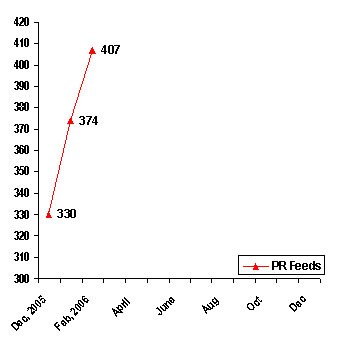
407 PR Blogs Worldwide

Blogs on the topic of PR are on the rise. Constantin Basturea, who is a keeper of the "official" PR blog lists reports an addition of 55 new PR feeds in the month of February alone, bringing the total number of PR feeds to 407, an increase of 9 percent over January.

(Note: For you math majors, I am aware that the math doesn’t quite work, I am in the process of clarifying the numbers with Constantin).

I am running a friendly competition at Communication Overtones to predict the number of PR feeds at the end of 2006. The person that comes the closest without going over will win a fabulous prize.

I recommend you visit Constantin’s list of new PR blogs and visit a handful of these new sites. If one or two strikes your fancy, add them to your personalized news page at MyYahoo, MyMSN, Google's personalized home page or other feed readers to which you might already be subscribed.

I added the Publicity Hound to mine, which I keep at MyYahoo. A couple of the posts that I found interesting there:


What are some of the sites you liked from the new list and why?


Thursday, March 02, 2006

Does the News Release Need a Facelift?

The entire blogoshere is currently abuzz with a recurring them, is the press release dead? The theme, or meme, comes up every two months or so, and online writers have been declaring the death of the press release for years.

So much talk has occurred around the meme (or idea) of the press release is dead that whenever it comes up again, everyone writes a reactionary response about their entrenched opinion and goes on with their life, only to have another boxing round again in about two to three months. I admit that I have done it myself on my Communication Overtones blog.

I think that everyone agrees on the following points:
  • The press, or news release, is something that has been entrenched in the media/PR culture
  • The format can lead to overblown claims and other information
  • Reporters generally use information from only a fraction of the releases they receive
  • Some releases are written better than others

Very few have offered a true alternative, and fewer yet a sample of what they think a press release should look like. Here are a few that have:

I must admit that I like the idea of a modular news release. It fits with today’s mad pace of 24 hour news and is easy to read. I think that by linking to online sources and giving direct numbers, the “release” becomes even more valuable. If a reporter can get his or her story written with minimal contact with the PR folks it really is better. I work this way with reporters all the time and they usually appreciate it and call back for more information. However, Todd disagrees with me on this and wants to maintain a little more control.

All of this said, modular formatting, fact sheets or any other format we may dream up, does not prevent bad writing or a blatant marketing focus from emerging. So many have said it over the past few days – in the end it boils down to the competence of the human behind the format.

Wednesday, March 01, 2006

Blogging Don'ts: Tips for Increasing Blog Usability

As this team of bloggers gets off the ground, we are naturally looking for ideas and suggestions to learn from and share. Dr. Jakob Nielsen is a self described user advocate and principal of the Nielsen Norman Group which he co-founded with Dr. Donald A. Norman (former VP of research at Apple Computer). He has developed many articles and books with tips and how-tos. His Alertbox article on October 17, 2005 provided the Top Ten Design Mistakes of Weblog Usability. Here’s the list that he expands on in his article.

  1. No Author Biographies
  2. No Author Photo
  3. Nondescript Posting Titles
  4. Links Don't Say Where They Go
  5. Classic Hits are Buried
  6. The Calendar is the Only Navigation
  7. Irregular Publishing Frequency
  8. Mixing Topics
  9. Forgetting That You Write for Your Future Boss
  10. Having a Domain Name Owned by a Weblog Service

He says, “When you want to reach new readers who aren’t your mother, however, usability becomes important.”

Monday, February 27, 2006

Overview of Social Media and Tools

Beth Farrell and Luke Armour, graduate PR students at the Univeristy of Akron blog about the public nature of blogs and share a great Powerpoint presentation that they prepared for PRSSA students about Social Media. We recommend that you take a look at it as it is a good overview of Blogging and Podcasting, along with a list of tools.

Friday, February 24, 2006

Tips for PR Toddlers

I found a post by Blake Barbera about Guy Kawasaki’s blog. Blake reports that Guy is one of the original employees responsible for marketing the Mac when it was launched. Guy’s blog contains lots of tips like How to Become a More Effective Emailer, The Art of Schmoozing, How to Kick Butt On a Panel, How to Get a Standing Ovation, and The Art of Execution. Guy’s writing style is entertaining and informative. I will be sharing some of his suggestions around the office. Naturally, the fact that he is a Mac Guru makes him highly credible in my opinion.

The wet feet pr blog by the way focuses on “an ongoing look into public relations from an entry level standpoint.” I was first drawn to it because of a post encouraging PR pros to use blogging to mentor PR students as is occurring at SMU. Perhaps something we should consider once we’ve gotten our own feet wet.

Knowledge Workers Get Connected Today not Tomorrow!

An exciting tool has arrived for creative professionals. Well, not really new but it is fast and convenient. Changing content at the quick of a button is invaluable. Of course, wikis don't work everyone. There are some interdisciplinary challenges that arise from its use.

For example, wikis are used best for structured information; however, it may not be an invaluable tool for the creation of new ideas. The idea of wikis is not new, just an enhanced technology whose main design is to develop a workable flow of ideas, ie. promotion of communicationn interchange. Wikis encourage professionals to share their viewpoints and receive feedback on processes. There are very easy templates to use that will help with the navigation of this great tool.

Finally, it can be used for small group cooperation, knowledge management, individual psychology, societal norms and behaviors, and management skills and technical design.
Essentially, wikis are the old way we used to do focus groups and now with the advent of technology, we have taken this one step further to involve management strategies and processes.

What a neat tool?

By Erica Taylor

Educational Warfare:Technology vs. Humanities

Any person interested in public relations vis a vis educational opportunities and investments in the future educational programs would enjoy reading the article “Investing in ‘Science’ Means the Humanities Too.”

How does anyone compare the value of technologically-based professions with humanies-based professions and come through with anything valid? Since technology allows us to implement communication such as this blog, it’s invaluable, but without the bridge of communication that allows the technologists to share ideas with the humans :-), no technology will be used, regardless of its value.

Grassroots PR Force of 8,000

Advertising Age carried an article earlier this week about plans that pharmaceutical giant GlaxoSmithKline is making to win over a skeptical public. It plans to “deputize” its 8,000 sales representatives as “public relations ambassadors” to respond to the criticism of and the negative perceptions held about the pharmaceutical industry.

Michael Pucci, GlaxoSmithKline’s vice president of external advocacy, created the program which he is calling the ”Value of Medicine.” Sales people will be asked to talk to their families, Rotarians, Elks, Lions Club members, senior-citizen groups, weekly newspapers, schools and other community groups.

Armed with talking points and answers to tough questions, the sales force has been asked to go out and speak to Rotarians, Elks, Lions Club members, senior-citizen groups, weekly newspapers, schools and every community group they can think of. And Mr. Pucci said GSK has enough sales reps to cover every county in every state in the country.

The key message include:

  • Affordability of prescription medication;
  • How today’s medicines fund the next generation of blockbuster drugs;
  • Access to state and federal programs that offset drug prices; and,
  • Common misconceptions about direct-to-consumer advertising (such as television drug ads)

This grassroots PR effort, which aims to capitalize on research that shows people trust information if they understand its source and if they know the communicator. Katie Payne and also Robert at InfOpinions write about the Glaxo plans.

Friday, January 27, 2006

Does Size Matter?

I am a fan of great big stuff.

Do you need a big pair of scissors for a ribbon-cutting? An 18-inch tall giant alarm clock that really works? A gavel as big as the your boss' ego? Giant boxing gloves for a "showdown" between management and their employees at the company picnic? A baseball hat big enough to sit on for the next fundaraiser?

I had so many ideas just looking at this site than I have time to share. Thanks to my colleague Fran Stephenson for pointing it out to me.

So, get a big ice cream cone, sit back, and let the BIG ideas flow.


Wednesday, January 25, 2006

PRSA Strongly Objects to Undisclosed Paid Endorsements

Yesterday, the Public Relations Society of America Advocacy Committee issued an statement about paid media endorsements, such as the one purported to have been made to Audrey Lewis (a freelance writer whose articles appeared in The Birmingham Times) by Richard M. Scrushy, the former chief executive of HealthSouth, through her public relations firm the Lewis Group. It says, among other things that:

PRSA strongly objects to any paid endorsement that is not fully disclosed as such and is presented as objective news coverage. Such practices are clearly contrary to the PRSA Member Code of Ethics, which requires that public relations professionals engage in open, honest communications and fully disclose sponsors or financial interests involved in any paid communications activities. We encourage all public relations professionals to follow the responsible and ethical practice of public relations as outlined by our Code of Ethics.

Kudos to PRSA for standing firm on the principles of the PRSA Code of Ethics. Here is the New York Times article about the scandal (free subscription required)

Tuesday, January 24, 2006

Finding PR Blogs - Getting Started

The recently started Daily Dog newsletter delivers up-to-date public relations news headlines in a daily e-mail that gives links to the Website to read more.

Last week, the Daily Dog added a PR blog roundup called The Blog Run to its daily offerings.

It is a great way to sample the more than 330 public relations blogs out there without becoming overwhelmed. You can also visit Pub Subs PR List to see which are the most popular blogs on any given day.

Monday, January 16, 2006

Online Rumor Empties Warren High School

Recently, I posted about a rumor on my blog Communication Overtones that led to the second tragedy at Sago Mine which left family members believing that their loved ones were alive when indeed they were not. This rumor was thought to be spread primarily by cellphone.

There are also many more examples of how rumor can make a huge impact in a crisis event.

At the PRSA San Antonio monthly luncheon on January 5, 2005, Pascual Gonzalez, principal spokesperson for the Northside Independent School District and the San Antonio chapter’s PR Professional of the Year, gave a crowd of over 60 PR practioners an idea of how pervasive a rumor can be.

In early October (before I was a blogger), a rumor posted at the popular social networking site myspace.com warned of an imminent shooting at Warren High School in San Antonio, Texas.

The school was effectively shut down for two days because many of its 3,000 students refused to return.

I live behind the school, so I followed the story with some interest.

A handful of students were believed to be involved with the spread of the rumor. However, there wasn't a real threat – just some influential kids talking.

This shows us that a very few influential people, in this case a “handful” of students with a myspace web page (which includes a blog and linking capabilities through its “My Friend Space”), can move an entire population of 3,000 students and their parents to take immediate action.

This is also a good case study of the power of social media.

Not to keep harping on the Tipping Point, but this is Gladwell’s “rule of the few” in action.

The school successfully worked with myspace.com to get the rumor taken off of the site.

Here is the story and the editorial about this incident at the San Antonio Express-News.

Thursday, January 12, 2006

PRSA Logo

Welcome to PRSA San Antonio Blog

We are excited to start this blog to communicate more effectively about public relations in San Antonio, Texas, and to advocate for the PR profession.

You can find out more about PRSA San Antonio and information about upcoming events at our Website.

We will have a team of PR Bloggers to update this site. So, if you are a PRSA member in San Antonio and you want to joing the blogging team, just let us know by posting in the comments section. Be sure to fill in your e-mail address.